

Bioenergetics · NOTA-BIO-122
A Pattern Appears in the Aging Brain
By Carlos J. Pérez Pulido · ISHEA Institute ·
Notes from the Nature × DGIST Conference: certain cells fail first, certain regions collapse earlier, and resilience erodes slowly. A recurring pattern that calls for an energetic explanation.
Note — Short piece published openly. Thinking in progress, not a result.
🧩 A Pattern Appears in the Aging Brain
At the Nature × DGIST Conference, one insight kept repeating across talks:
Certain cells fail first. Certain regions collapse earlier. And resilience slowly fades.
Scientists call this selective vulnerability.
But the why? That question remains.
Here’s what struck me:
We often focus on what fails, where, and when.
But the story of the brain is also about energy flow.
⚡ Think of it like a city:
Each building (cell) needs power to function
Repairs cost energy
Waste removal costs energy
Stress demands extra energy
When the supply can’t meet demand, systems fail—not randomly, but in patterns.
Some cells are wired to be more vulnerable. Some regions pay the price first.
> The pattern is visible. The mechanism? Still unfolding.
But the lens of energy gives us a clue: vulnerability is rarely random.
This is why the next frontier in neuroscience is understanding these energy patterns, not just cataloging cell types.
— Carlos J. Pérez Pulido
ISHEA Institute
#Neuroscience #BrainHealth #EnergyMatters #AgingResearch #SystemsBiology #ComplexSystems #ISHEA #SelectiveVulnerability #SingleCell #Astrocytes #Microglia #CMA
In the same room — Bioenergetics
OSF-BIO-001 · Bioenergetics
Milestone Report: From Nature Conference Poster to the Two-Level Bioenergetic Coherence Model
Technical report and visual archive tracing one year of the ISHEA Δ±1 framework: from a 2025 Nature Conference poster in South Korea to its computational formalization with NAD+, ROS and ATP.
OSF-BIO-002 · Bioenergetics
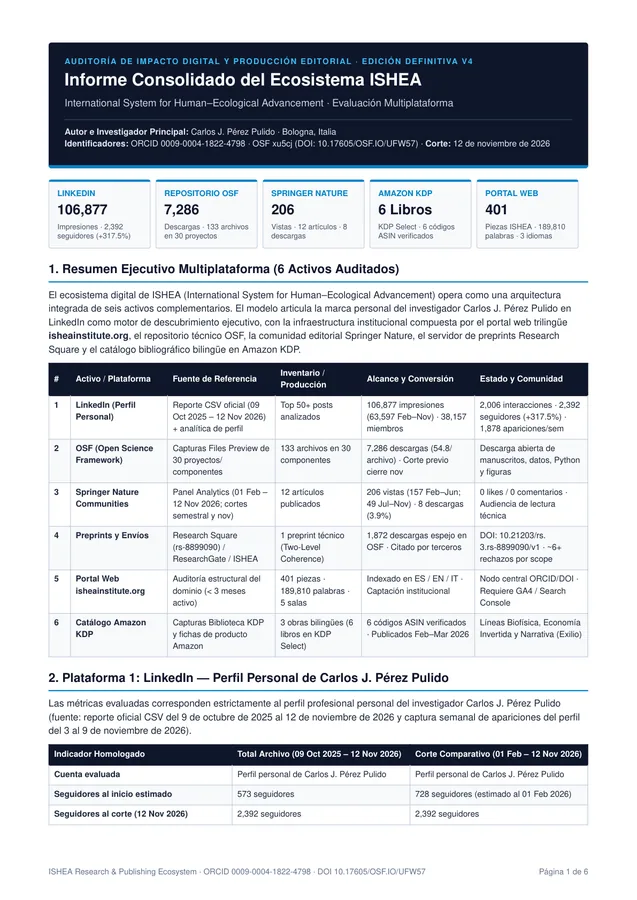
Multiplatform Performance Audit and Ecosystem Maturity Benchmark of ISHEA (2025–2026)
Report v4.1 measuring the reach of six ISHEA dissemination channels, from LinkedIn to OSF, with 106,877 impressions and 7,286 downloads. It shows how far its open-science infrastructure has matured.
NOTA-BIO-003 · Bioenergetics
The Nobel, optogenetics and a question I want to test
Carlos J. Pérez Pulido reflects on the 2026 Nobel Prize in Physiology or Medicine, awarded to Deisseroth, Hegemann and Nagel for optogenetics, and poses a question he intends to put to the test.