

Economy 5.0 · NOTA-ECO-051
An Experiment I Never Planned (2/4)
By Carlos J. Pérez Pulido · ISHEA Institute ·
A warehouse in the Netherlands brings together young workers from Spain, Portugal, Poland, Romania and Turkey. Same shift, same load: an involuntary laboratory on energy and work.
Note — Short piece published openly. Thinking in progress, not a result.
Original piece in Spanish.
2/4🧠UN EXPERIMENTO QUE NO PLANIFIQUÉ.
Trabaje en un warehouse en Holanda.
Y llevo semanas observando algo que no puedo ignorar.
Jóvenes de España, Portugal, Polonia, Rumania, Turquía.
Todos aquí. Todos haciendo el mismo sacrificio.
¿Qué tienen en común?
---
NO ES CASUALIDAD. ES FRICCIÓN. ⚡**
Recuerda lo que dijimos sobre el cerebro:
El sistema busca siempre el camino de menor resistencia.
Pero ¿qué pasa cuando ese camino no existe en tu país?
Cuando el sistema donde naciste tiene tanta fricción estructural que construir un presente ahí se vuelve imposible.
No es que estos jóvenes sean más valientes.
Es que su entorno les cerró las salidas.
---
**EL SACRIFICIO COMO ESTRATEGIA BIOLÓGICA 🔬**
Aceptan un costo energético mayor hoy —
trabajo físico, idioma nuevo, invierno holandés, cultura diferente —
porque su cerebro hizo el cálculo:
→ Fricción en Holanda = temporal y con salida
→ Fricción en casa = permanente y sin futuro
No es romanticismo.
Es optimización de supervivencia.
---
**LO QUE ME SORPRENDE 🌍**
España. Portugal. Polonia. Rumania. Turquía.
Países distintos. Culturas distintas. Idiomas distintos.
Pero el mismo destino: un warehouse en los Países Bajos.
Y el mismo patrón:
Sistemas que generan tanta fricción interna que exportan a sus mejores jóvenes.
No emigran los que se rinden.
Emigran los que todavía creen que vale la pena intentarlo.
---
**LA PREGUNTA QUE ME QUEDO 💡**
¿Qué tipo de sistema construye fricción suficiente para que su propia gente prefiera el sacrificio fuera antes que la estabilidad dentro?
Y más importante:
¿Cuánto talento está perdiendo Europa por sistemas que no saben organizarse?
---
*"Los sistemas no fallan por falta de recursos. Fallan porque no saben organizarlos."*
— Economía Invertida · Carlos J. Pérez Pulido
#ISHEA #Holanda #Migración #Europa #Fricción #Economía #Juventud #Talento #Reflexión 🚀
In the same room — Economy 5.0
SN-ECO-001 · Economy 5.0
Circular Economy Must Begin at the Design Stage: An ISHEA Perspective on Economy 5.0
The next step in the circular economy is not recovering more but designing to lose less. Economy 5.0 joins Digital Twins, biophysical management, circular design and sustainable finance to preserve systemic value.
SN-ECO-002 · Economy 5.0
Economy 5.0: Beyond Energy and Carbon — Toward Systemic Coherence
ISHEA's proposal for Economy 5.0: a human-centred economic framework that looks past energy, carbon and efficiency to systemic coherence, human capabilities and the capacity of economies to adapt and endure.
OSF-ECO-003 · Economy 5.0
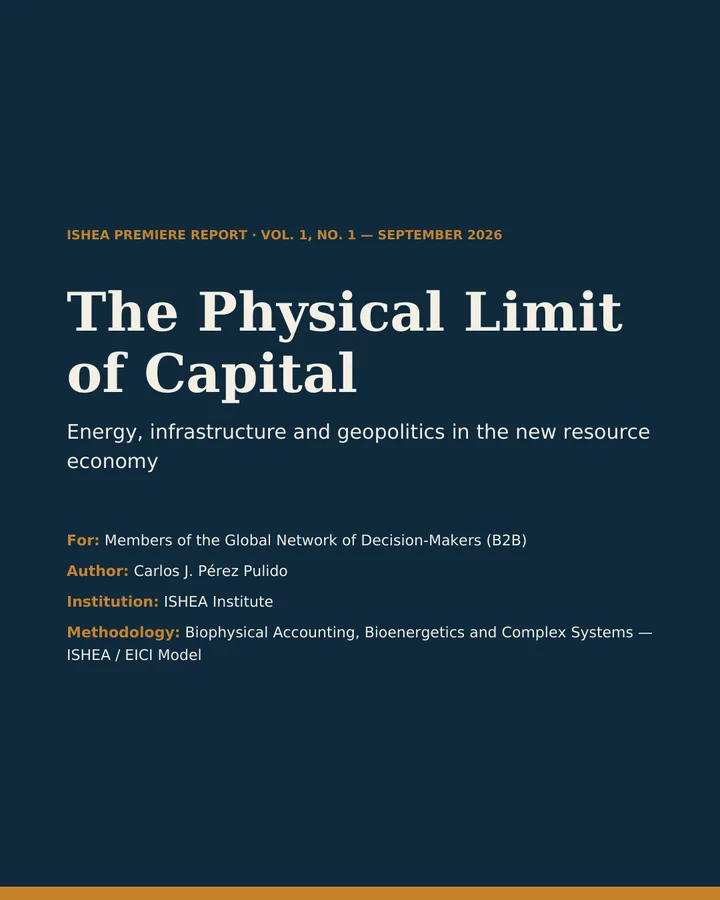
The Physical Limit of Capital: Energy, Infrastructure and Geopolitics
The ISHEA Institute's premiere report examines how AI infrastructure, energy and mineral supply chains and maritime corridors set how much financial capital can become real economic activity.