

Bioenergetics · OSF-BIO-110
Bioenergetic coherence as a determinant of neuronal function: an in silico validation
By Carlos J. Pérez Pulido · ISHEA Institute ·
Simulations of calcium dynamics, CaMKII and mitochondrial ATP show that identical stimulation yields opposite fates depending on available energy: imbalance precedes excitotoxic collapse
Preprint — Manuscript deposited on OSF. Not peer-reviewed.

This report presents a systems-level, in silico validation framework demonstrating that neuronal information processing, plasticity, and survival are causally constrained by bioenergetic coherence. Using publicly documented parameters for calcium dynamics, CaMKII activation, and mitochondrial ATP/NADH production, simulations show that identical electrical stimulation patterns yield fundamentally different outcomes depending on energy availability. The framework highlights that neuronal vulnerability is state-dependent, with energetic imbalance preceding excitotoxic collapse and propagating across networks. Observations are fully reproducible, non-proprietary, and provide a mechanistic basis for understanding neurodegeneration from an energy-centric systems perspective.
Keywords:
Neuronal bioenergetics, Ca²⁺ dynamics, CaMKII, ATP/NADH, in silico validation, energetic coherence, neurodegeneration, network dynamics
Bioenergetic Coherence as a Determinant of Neuronal Function
Bioenergetic Coherence as a Determinant of Neuronal Function is a scientific perspective and in silico validation report authored by Carlos J. Pérez Pulido at the ISHEA Institute. The work investigates how neuronal information processing, plasticity, and survival depend on the energetic state of the system, rather than on electrical stimulation patterns alone.
Using computational simulations of calcium dynamics (Ca²⁺), CaMKII activation, and mitochondrial ATP/NADH availability, the study demonstrates that identical electrical inputs can produce either normal neuronal function or excitotoxic collapse depending on bioenergetic efficiency. The framework models neurons as dynamic systems where energy supply constrains information processing, plasticity, and network stability.
Key findings include:
Neuronal function is state-dependent, not stimulus-dependent.
Energetic imbalance precedes molecular or electrophysiological failure.
Dysfunction can propagate through neuronal networks even without overt pathology.
Ca²⁺ dynamics act as primary informational mediators, while ATP and NADH act as enabling constraints.
The report emphasizes reproducibility and transparency, using publicly available parameters and open-source computational methods. It offers a systems-level interpretation of neurodegeneration, suggesting that energetic coherence is a critical organizing principle for neuronal health and network resilience.
In the same room — Bioenergetics
NOTA-BIO-001 · Bioenergetics
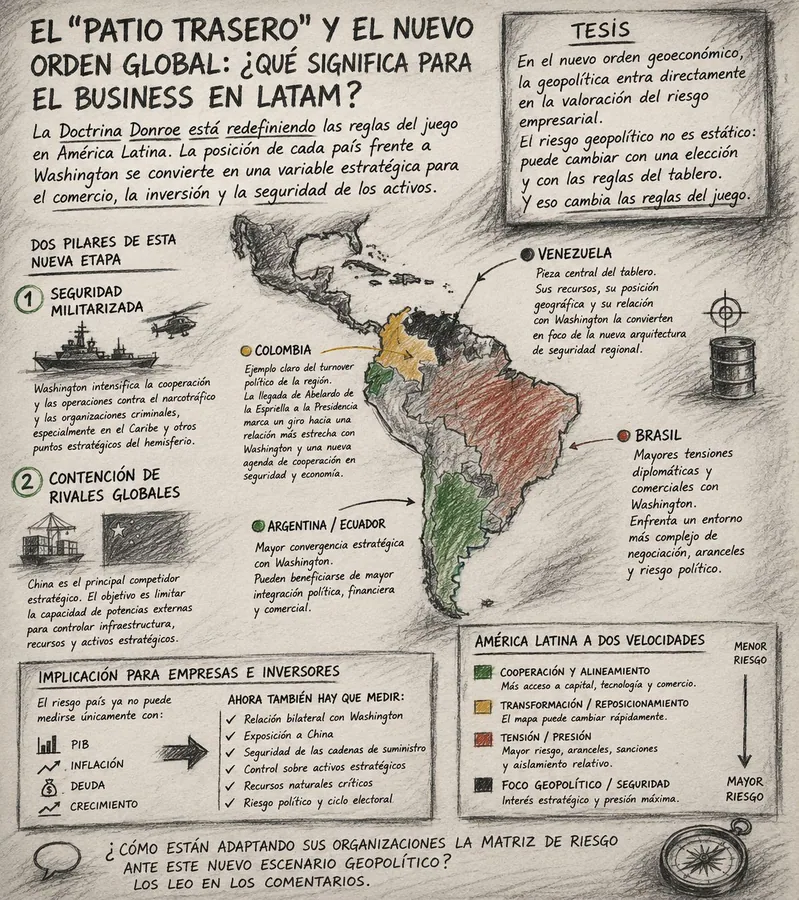
The “Backyard” and the New Global Order: What Does It Mean for the Business Plan in LatAm?
An analysis of how the so-called Donroe Doctrine has turned the “backyard” metaphor into explicit policy, and what that shift means for any business plan built for Latin America.

NOTA-BIO-002 · Bioenergetics
Why do the most efficient workers slow down midway through the workday?
For operations directors and logistics managers: a bioenergetic reading of why top performers lose productivity midway through the workday, a pattern many see and few explain.

NOTA-BIO-003 · Bioenergetics
Threat or opportunity? Artificial intelligence and our creative capacity
Responding to Pope Leo XIV’s call to “disarm AI”, this piece argues that the risk lies not in the technology but in the human system using it: well designed, AI can free up creative capacity.