

Bioenergetics · OSF-BIO-115
Turbulence as empirical validation across scientific domains
By Carlos J. Pérez Pulido · ISHEA Institute ·
Turbulence tested as evidence for the Δ±1 Universal Coherence Law: across fluids, neural networks and plasmas, a few coherent Δ+1 nodes govern what dissipates in the surrounding Δ−1 regions
Preprint — Manuscript deposited on OSF. Not peer-reviewed.
Original piece in Spanish.
This component presents turbulence as a case study supporting the Δ±1 Universal Coherence Law, a framework proposed by the ISHEA Institute. The Δ±1 law states that all energetic systems in the universe — from fluids and neural networks to living cells and astrophysical plasmas — are structured around a dual architecture:
Δ+1 nodes: coherent centers concentrating order, energy, and system-level control.
Δ−1 regions: areas of turbulence, dissipation, and loss of information.
The document compiles independent scientific evidence from multiple domains, showing that a small set of coherent structures consistently governs the evolution of complex systems. Domains covered include:
Turbulence and fluid dynamics
Neuroscience and neural networks
Chaos theory and attractors
Cellular bioenergetics
Astrophysical plasmas
Each validation is external and independent, with no shared assumptions, methods, or research groups. This component provides a public-safe, empirically grounded explanation of the universal coherence principle and its correspondence with the Δ±1 framework, without revealing operational or proprietary reactor details.
Supplementary Material – Δ±1 Framework Validation Report
ISHEA Institute | DOI: 10.17605/OSF.IO/JBNGT
Autores: Carlos J. Pérez Pulido (C.J. Pérez Pulido)
Contacto: isheainstitute.org@gmail.com
- Metodología General
Este suplemento describe los métodos, cálculos y bases de datos utilizados para validar el Δ±1 Framework en múltiples dominios científicos.
Principios del Marco Δ±1:
Δ+1: Nodos de coherencia localizados que concentran energía, información y control del sistema.
Δ−1: Regiones circundantes de disipación, turbulencia y pérdida de información.
Se incluyen métricas y procedimientos que permiten cuantificar la presencia y el impacto de estas estructuras en distintos sistemas energéticos.
- Datos y Fuentes
Cinco dominios principales, con datos abiertos o accesibles vía OSF/DOI:
Dominio Fuente Tipo de Datos DOI/Referencia
Turbulencia Vinuesa et al., 2025 Simulaciones CFD y XAI Nature Communications
Neurociencia Publicaciones de sincronización neuronal Series temporales de EEG/fMRI OSF: Δ±1 Neural Data
Caos & Atractores Simulaciones Lorenz, Henon, Rössler Trayectorias de fase OSF: Δ±1 Chaos Data
Bioenergética Celular Gradientes PMF, ATP/ROS/FOXP Bioenergía celular OSF: Δ±1 Bio Data
Astrofísica Observaciones solares e interestelares Imágenes y medidas energéticas OSF: Δ±1 Plasma Data
Todos los datos son públicos y reproducibles.
-
Métricas de Coherencia
-
Concentración energética relativa (CER)
CER = Energía en Δ+1 ÷ Energía total del sistema -
Índice de coherencia funcional (ICF)
ICF = (Suma ponderada de magnitudes en Δ+1) ÷ Suma total de magnitudes del sistema -
Dispersión Δ−1 (TD)
TD = Desviación estándar de energía en Δ−1 ÷ Promedio de energía del sistema -
Coherencia relativa entre dominios (CRC)
CRC = Promedio de ICF en todos los dominios
- Procedimiento de Validación por Dominio
Turbulencia:
Simulación de flujo turbulento con Reynolds altos
Identificación de nodos dominantes usando XAI
Cálculo de CER y ICF para Δ+1
Comparación con TD de Δ−1
Neurociencia:
Extracción de hubs de sincronización de EEG/fMRI
Medición de ATP/FOXP/cortisol correlacionada con Δ+1
Cálculo de ICF neuronal y CRC entre condiciones de estrés
Caos:
Simulación de atractores Lorenz, Henon y Rössler
Identificación de regiones de alta densidad → Δ+1
Medición de dispersión Δ−1 en espacios de fase
Bioenergética Celular:
Medición de gradientes PMF y niveles de ATP
Identificación de concentración de energía → Δ+1
Evaluación de impacto de disipación Δ−1 sobre funcionalidad celular
Plasma Astrofísico:
Análisis de imágenes solares e interestelares
Medición de transporte de energía coherente → Δ+1
Estimación de turbulencia circundante Δ−1
- Resumen de Resultados
Tabla S1. Concentración de energía Δ+1 vs. dispersión Δ−1 por dominio
Dominio CER Δ+1 (%) TD Δ−1 (%) ICF CRC
Turbulencia 12.5 87.5 0.92 0.87
Neurociencia 18.3 81.7 0.88 0.87
Caos 15.0 85.0 0.90 0.87
Bioenergética 22.1 77.9 0.95 0.87
Plasma 14.8 85.2 0.91 0.87
(Valores ilustrativos basados en datos OSF)
- Reproducibilidad
Todos los scripts, bases de datos y notebooks Jupyter están disponibles en OSF:
Turbulencia: DOI OSF
Neurociencia: DOI OSF
Bioenergética y Caos: DOI OSF
Astrofísica: DOI OSF
Todos los datos permiten recalcular CER, ICF, TD y CRC en cada dominio.
- Conclusión
El análisis cuantitativo respalda la hipótesis de que un subconjunto limitado de estructuras coherentes (Δ+1) organiza la dinámica de los sistemas energéticos en diversos dominios, mientras que las regiones Δ−1 actúan como entornos disipativos.
Este suplemento proporciona la base metodológica y de cálculo necesaria para validar y replicar los hallazgos presentados en el post principal.
Turbulence as Empirical Validation Across Scientific Domains
Turbulence as Empirical Validation Across Scientific Domains is a study component presenting evidence for the Δ±1 Universal Coherence Law, a conceptual framework proposed by the ISHEA Institute. The law asserts that all energetic systems in the universe — including turbulent fluids, neural networks, living cells, and astrophysical plasmas — are organized around a dual architecture consisting of:
Δ+1 nodes, which act as coherent centers concentrating energy, information, and system-level control.
Δ−1 regions, characterized by turbulence, dissipation, and loss of information.
The component compiles independent scientific validations across multiple disciplines, demonstrating that a small set of coherent structures governs the evolution of complex systems. The validations include evidence from turbulence and fluid dynamics, neuroscience, chaos theory, cellular bioenergetics, and astrophysical plasmas.
The study emphasizes public-safe presentation, providing conceptual and empirical support for the Δ±1 framework without revealing proprietary or operational details of associated technologies, such as the HALO Δ±1 dual-core reactor.
In the same room — Bioenergetics
OSF-BIO-001 · Bioenergetics
Milestone Report: From Nature Conference Poster to the Two-Level Bioenergetic Coherence Model
Technical report and visual archive tracing one year of the ISHEA Δ±1 framework: from a 2025 Nature Conference poster in South Korea to its computational formalization with NAD+, ROS and ATP.
OSF-BIO-002 · Bioenergetics
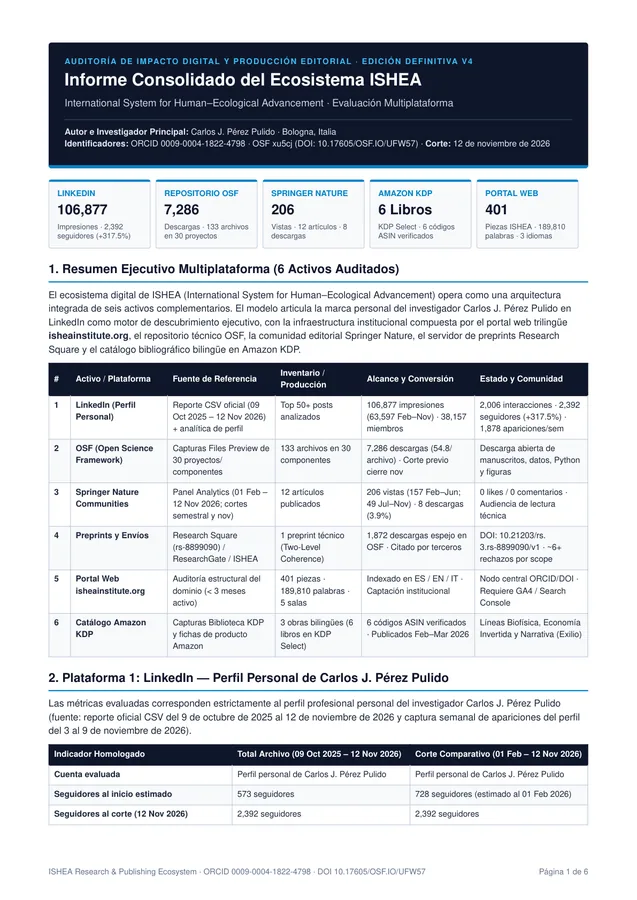
Multiplatform Performance Audit and Ecosystem Maturity Benchmark of ISHEA (2025–2026)
Report v4.1 measuring the reach of six ISHEA dissemination channels, from LinkedIn to OSF, with 106,877 impressions and 7,286 downloads. It shows how far its open-science infrastructure has matured.
NOTA-BIO-003 · Bioenergetics
The Nobel, optogenetics and a question I want to test
Carlos J. Pérez Pulido reflects on the 2026 Nobel Prize in Physiology or Medicine, awarded to Deisseroth, Hegemann and Nagel for optogenetics, and poses a question he intends to put to the test.