

Collective cognition · OSF-COG-013
Biophysical Management in physical labor environments: automatism and coherence
By Carlos J. Pérez Pulido · ISHEA Institute ·
Derived from the ISHEA Δ±1 framework and grounded in a high-volume logistics warehouse: penalizing the fastest workers with fewer hours dismantles motor automatism and erodes sustainable productivity.
Preprint — Manuscript deposited on OSF. Not peer-reviewed.
This working paper introduces Biophysical Management (BPM), a framework derived from the ISHEA Δ±1 Coherence Framework, and applies it to direct field observation in a high-volume logistics warehouse operated by Arvato in the Netherlands. Seven propositions are developed linking motor automatism, metabolic coherence, psychological safety, structured recovery, cross-role rotation, and participatory feedback to sustainable productivity in physical labor contexts.
The paper's central and original contribution is the identification of a structural neurobiological failure in prevailing logistics compensation models: when efficient workers are penalized through reduced working hours upon early task completion, the dopaminergic reward circuit is systematically suppressed. Drawing on Skinner (1938), Schultz et al. (1997), Deci & Ryan (1985), and Kahneman & Tversky (1979), the paper demonstrates that efficiency-penalizing compensation structures extinguish productive behavior with neurobiological certainty — producing the performance degradation operators attribute to worker attitude or culture.
The study is qualitative, exploratory, and hypothesis-generating, intended as a foundation for future empirical investigation with biometric instrumentation and quantitative productivity analysis.
This preprint presents a qualitative case study on Biophysical Management (BPM) — an applied framework derived from the ISHEA Δ±1 Coherence Framework (Pérez Pulido, 2025) — conducted through direct participatory observation in a major logistics fulfillment operation, Netherlands (2025).
The study integrates concepts from cognitive psychology, psychophysiology, behavioral economics, and organizational behavior to argue that human productivity in physical labor is governed by biophysical laws rather than motivational or cultural factors.
Seven core propositions are developed:
Motor automatism reduces metabolic expenditure and sustains output. Rhythmic task structures promote systemic coherence. Positive psychophysiological state mediates productivity. Threat-based management degrades neurological performance capacity. Cross-role rotation post-automatism expands collective coherence. Participatory feedback functions as real-time friction data. Compensation structures that penalize efficiency suppress dopaminergic reward and extinguish productive behavior.
Central finding (P7): In time-based compensation models where early task completion reduces paid hours, the efficient worker's net economic outcome is negative — greater metabolic expenditure, lower income. The brain's reward prediction system registers this as punishment, suppresses dopamine release, and extinguishes the efficient behavior through operant conditioning. The reward zone is never activated. The system trains its workforce not to perform.
Proposed solutions include output-based bonus structures, guaranteed floor compensation, and efficiency-sharing models that convert operator margin gains into worker reward signals — realigning economic incentives with neurobiological reinforcement.
Keywords: biophysical management, ISHEA framework, motor automatism, dopaminergic reward, efficiency trap, logistics management, compensation design, metabolic coherence, organizational psychophysiology.
Author: Carlos J. Pérez Pulido — Founder & Director of Research, ISHEA Institute. ORCID: 0009-0004-1822-4798
In the same room — Collective cognition
NOTA-COG-001 · Collective cognition
PISA 2025: what happens when learning too fast stops being learning?
A reading of the PISA 2025 results and the signal they send about performance across OECD countries: the suspicion that speeding up learning may end up hollowing it out.
NOTA-COG-002 · Collective cognition
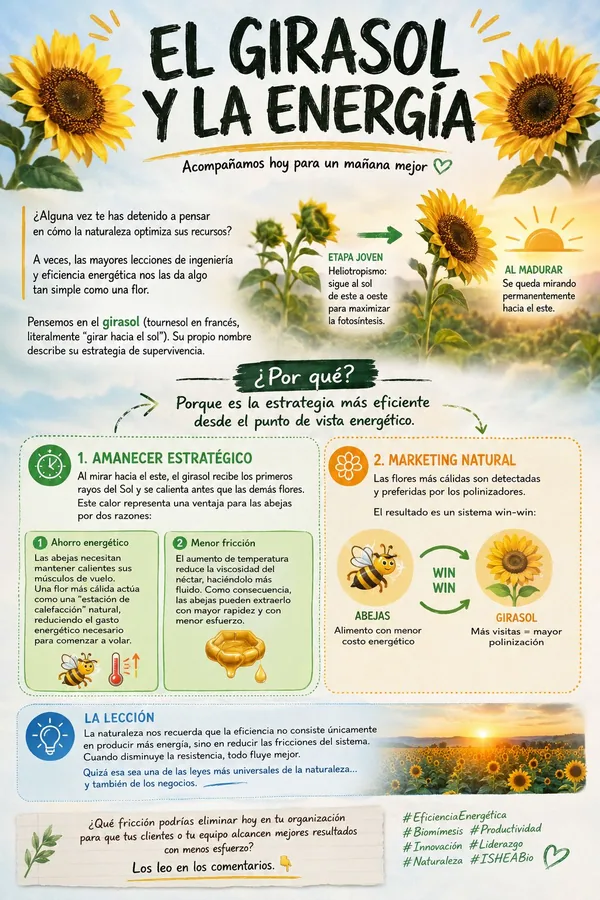
The Sunflower and Energy
How nature optimises its resources: the sunflower turns its geometry into a lesson in engineering and energy efficiency that human technology is still trying to match.
OSF-COG-003 · Collective cognition
ICSD: cognitive state dynamics (in preparation)
A repository in preparation for ICSD, the cognitive state dynamics model; it opens the space where the materials of the EICI + TACC framework will be deposited as the research advances.