

Bioenergetics · NOTA-BIO-049
The human brain did not evolve through new genes, but through a new control system
By Carlos J. Pérez Pulido · ISHEA Institute ·
A reading of Li et al. (2025) on the two regulatory shifts that reshaped the human brain: the novelty lay not in unprecedented genes, but in how their expression is governed.
Note — Short piece published openly. Thinking in progress, not a result.
Original piece in Spanish.
🧠 El cerebro humano no evolucionó con nuevos genes. Evolucionó con un nuevo sistema de control.
Un estudio reciente (Li et al., 2025 — Quantitative Biology, Wiley) identificó dos momentos en nuestra historia evolutiva donde el control genético cambió abruptamente. No los genes en sí — sino cómo se activan. Cuándo. Con qué intensidad. En respuesta a qué.
Memoria, lenguaje, emoción, cognición social.
Todo moldeado por esas dos transiciones.
No fue una mutación de hardware.
Fue una reconfiguración del sistema de control.
Esto nos invita a una pregunta que desde la biofísica de sistemas encontramos fundamental:
¿Qué determina cuándo un sistema biológico da un salto cualitativo?
No la cantidad de sus componentes.
Sino la coherencia entre energía disponible, información integrada y fricción estructural.
Es una lógica que aparece en física, en biología, en sistemas cognitivos.
Y que proponemos formalizar bajo el marco ISHEA Δ±1.
El trabajo de Li et al. es, desde esa perspectiva, un valioso punto de convergencia.
📄 DOI: 10.1002/qub2.88
🔗 ISHEA Institute | OSF: https://lnkd.in/ecCE5A8P
#Biofísica #Neurociencia #EvoluciónCognitiva #SistemasComplejos #Epigenética #ISHEA #CienciaEnEspañol
In the same room — Bioenergetics
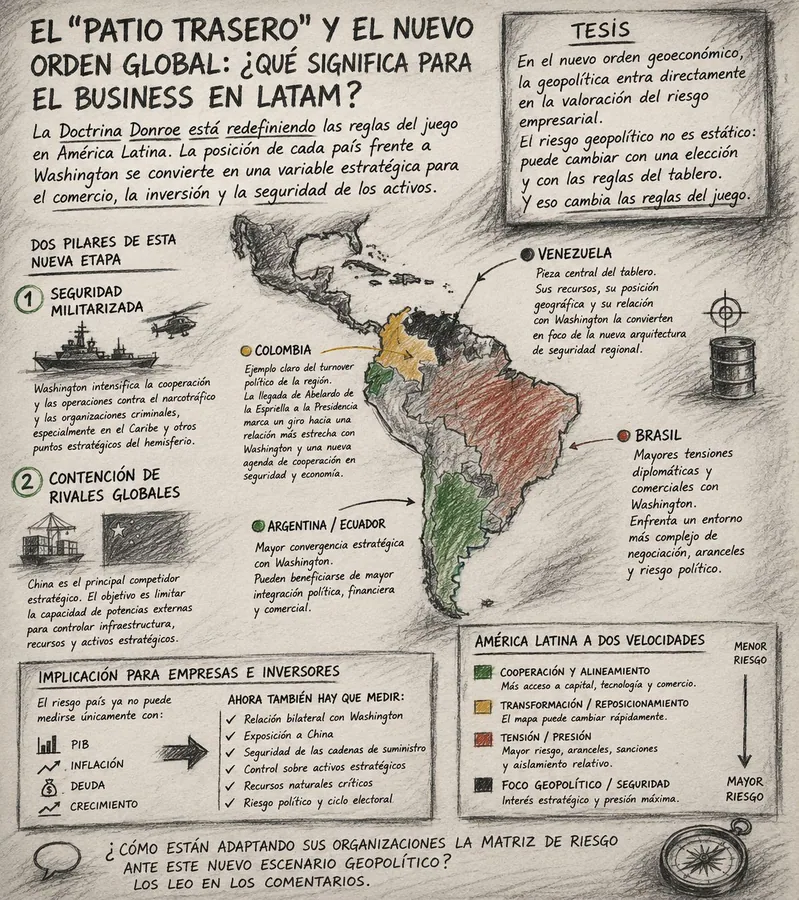
NOTA-BIO-001 · Bioenergetics
The “Backyard” and the New Global Order: What Does It Mean for the Business Plan in LatAm?
An analysis of how the so-called Donroe Doctrine has turned the “backyard” metaphor into explicit policy, and what that shift means for any business plan built for Latin America.

NOTA-BIO-002 · Bioenergetics
Why do the most efficient workers slow down midway through the workday?
For operations directors and logistics managers: a bioenergetic reading of why top performers lose productivity midway through the workday, a pattern many see and few explain.

NOTA-BIO-003 · Bioenergetics
Threat or opportunity? Artificial intelligence and our creative capacity
Responding to Pope Leo XIV’s call to “disarm AI”, this piece argues that the risk lies not in the technology but in the human system using it: well designed, AI can free up creative capacity.