

Economía 5.0 · OSF-ECO-140
Dossier 5 — Sistemas complejos: mercados, computación y sistemas militares
Por Carlos J. Pérez Pulido · ISHEA Institute ·
Mercados, computación y ejércitos leídos como una misma arquitectura: ceden cuando el propósito se aleja del valor real, la transmisión se corrompe o falta resiliencia. ISHEA como ley transversal de estabilidad.
Preprint — Manuscrito depositado en OSF. Sin revisión por pares.
Pieza original en inglés.
This dossier analyzes markets, computing, and military systems as complex structures governed by the ISHEA–KTR–TACC–IHC model. It shows that markets collapse when Purpose (K) diverges from real value, computing fails when Transmission (T) is corrupted, and armies weaken when Resilience (R) is insufficient. Complex systems thus validate ISHEA as a transversal law of systemic stability.
⚙ Exp. 5– Complex Systems: Markets, Computing, and Military
Systems Validation of the ISHEA–KTR–TACC–IHC Model
Author: Carlos Pérez Pulido
Period: 20th–21st Century Case Studies
Overview
This dossier applies the ISHEA–KTR–TACC–IHC framework to complex systems beyond biology or society, focusing on three domains:
1. Markets, where speculation and purpose misalignment (K) lead to crises.
2. Computing systems, where transmission (T) failures generate breakdowns.
3. Military organizations, where resilience (R) determines survival and performance.
The analysis shows that systemic collapses in these domains follow the same K–T–R dynamics observed in health, ecology, and history.
Key Insights
- Markets:
- When Purpose (K) diverges from real value (speculation, bubbles), systems become unstable.
- Transmission (T) failures, such as misinformation or lack of transparency, increase volatility.
-
Crises emerge when Resilience (R) mechanisms (regulation, buffers) are insufficient.
-
Computing Systems:
- Fragility arises when Transmission (T) is corrupted (software bugs, network failures).
- Purpose (K) without security alignment creates systemic risk (cyberattacks, blackouts).
-
Resilience (R) depends on redundancy, modularity, and adaptive protocols.
-
Military Systems:
- Military resilience relies on morale, logistics, and redundancy.
- Collapse occurs when Purpose (K) is fragmented (unclear mission), Transmission (T) fails (command breakdown), or Resilience (R) is overwhelmed.
- Historical examples confirm that wars are won or lost on KTR alignment.
Hypotheses
- H24.1: Markets collapse when K (purpose) diverges from value, regardless of short-term growth.
- H24.2: Computing systems fail primarily through Transmission (T) breakdowns.
- H24.3: Military performance depends on R (resilience) but requires alignment with K and T.
Results (Conceptual Validation)
- Financial crises (2008, crypto bubbles) validate that markets collapse without coherent K.
- Major outages (cloud service crashes, cyber incidents) demonstrate the fragility of T in computing.
- Military case studies (Iraq 2003, Afghanistan 2021) confirm that armies fail when purpose erodes and communication collapses.
Conclusion
Complex systems validate the universality of ISHEA:
- Markets prove the danger of misaligned K.
- Computing illustrates the centrality of T.
- Military confirms the role of R.
Across domains, systemic collapse follows the same K–T–R cycle, reinforcing ISHEA as a transversal law of resilience and failure.
Suggested Files
- exp24_complex_systems.md
- exp24_complex_systems_dataset.csv
- exp24_complex_systems_analysis.py
- figures/exp24_markets_crisis.png
- figures/exp24_computing_failures.png
- figures/exp24_military_resilience.png
En la misma sala — Economía 5.0

NOTA-ECO-001 · Economía 5.0
¿Y si las variables con las que medimos el éxito de los países estuvieran al revés?
Durante décadas el progreso se ha medido con PIB, productividad, crecimiento y energía. Esta pieza plantea que esas variables podrían estar invertidas y pide repensar qué significa que un país prospere.
NOTA-ECO-002 · Economía 5.0
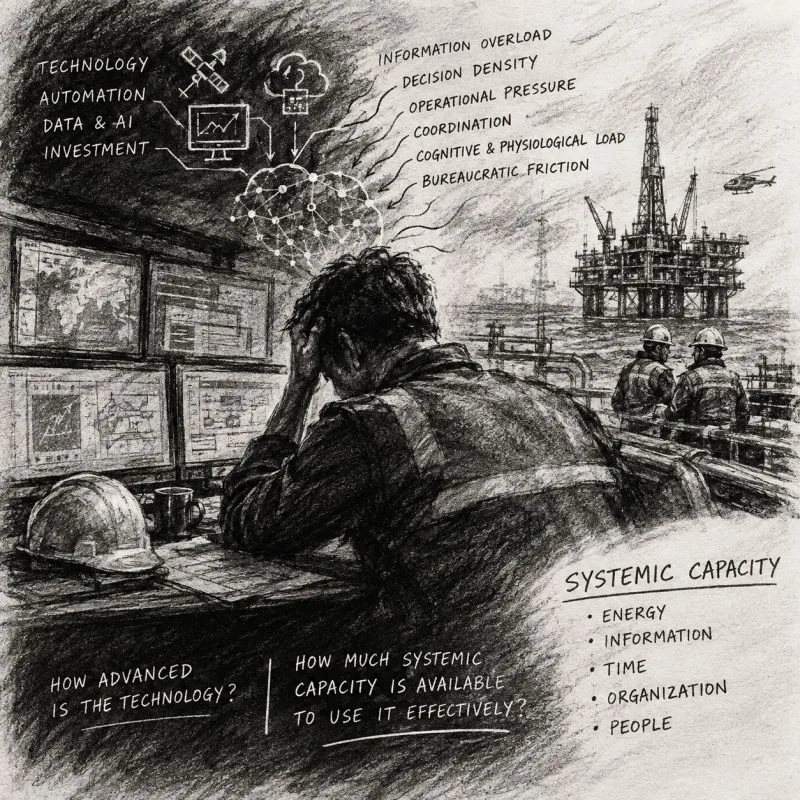
¿Por qué fallan los sistemas de alta ingeniería cuando la tecnología es más avanzada?
En Oil & Gas y otras operaciones complejas, más tecnología no garantiza mejores decisiones: esta pieza estudia la capacidad sistémica, lo que un sistema puede absorber y convertir en acción bajo presión.

NOTA-ECO-003 · Economía 5.0
Frankenstein y el petróleo: ¿por qué Venezuela vuelve a importar geopolíticamente?
Tercera entrega de la serie: tras el paso del capital a la IA y a la concentración financiera, llega el siguiente cuello de botella, el petróleo, y con él Venezuela vuelve al tablero geopolítico.