

Economy 5.0 · OSF-ECO-140
Dossier 5 — Complex systems: markets, computing and military structures
By Carlos J. Pérez Pulido · ISHEA Institute ·
Markets, computing and armies read as a single architecture: they fail when purpose drifts from real value, when transmission is corrupted, or when resilience runs short. ISHEA as a transversal law of stability.
Preprint — Manuscript deposited on OSF. Not peer-reviewed.
This dossier analyzes markets, computing, and military systems as complex structures governed by the ISHEA–KTR–TACC–IHC model. It shows that markets collapse when Purpose (K) diverges from real value, computing fails when Transmission (T) is corrupted, and armies weaken when Resilience (R) is insufficient. Complex systems thus validate ISHEA as a transversal law of systemic stability.
⚙ Exp. 5– Complex Systems: Markets, Computing, and Military
Systems Validation of the ISHEA–KTR–TACC–IHC Model
Author: Carlos Pérez Pulido
Period: 20th–21st Century Case Studies
Overview
This dossier applies the ISHEA–KTR–TACC–IHC framework to complex systems beyond biology or society, focusing on three domains:
1. Markets, where speculation and purpose misalignment (K) lead to crises.
2. Computing systems, where transmission (T) failures generate breakdowns.
3. Military organizations, where resilience (R) determines survival and performance.
The analysis shows that systemic collapses in these domains follow the same K–T–R dynamics observed in health, ecology, and history.
Key Insights
- Markets:
- When Purpose (K) diverges from real value (speculation, bubbles), systems become unstable.
- Transmission (T) failures, such as misinformation or lack of transparency, increase volatility.
-
Crises emerge when Resilience (R) mechanisms (regulation, buffers) are insufficient.
-
Computing Systems:
- Fragility arises when Transmission (T) is corrupted (software bugs, network failures).
- Purpose (K) without security alignment creates systemic risk (cyberattacks, blackouts).
-
Resilience (R) depends on redundancy, modularity, and adaptive protocols.
-
Military Systems:
- Military resilience relies on morale, logistics, and redundancy.
- Collapse occurs when Purpose (K) is fragmented (unclear mission), Transmission (T) fails (command breakdown), or Resilience (R) is overwhelmed.
- Historical examples confirm that wars are won or lost on KTR alignment.
Hypotheses
- H24.1: Markets collapse when K (purpose) diverges from value, regardless of short-term growth.
- H24.2: Computing systems fail primarily through Transmission (T) breakdowns.
- H24.3: Military performance depends on R (resilience) but requires alignment with K and T.
Results (Conceptual Validation)
- Financial crises (2008, crypto bubbles) validate that markets collapse without coherent K.
- Major outages (cloud service crashes, cyber incidents) demonstrate the fragility of T in computing.
- Military case studies (Iraq 2003, Afghanistan 2021) confirm that armies fail when purpose erodes and communication collapses.
Conclusion
Complex systems validate the universality of ISHEA:
- Markets prove the danger of misaligned K.
- Computing illustrates the centrality of T.
- Military confirms the role of R.
Across domains, systemic collapse follows the same K–T–R cycle, reinforcing ISHEA as a transversal law of resilience and failure.
Suggested Files
- exp24_complex_systems.md
- exp24_complex_systems_dataset.csv
- exp24_complex_systems_analysis.py
- figures/exp24_markets_crisis.png
- figures/exp24_computing_failures.png
- figures/exp24_military_resilience.png
In the same room — Economy 5.0

NOTA-ECO-001 · Economy 5.0
What if the variables we use to measure national success were completely backwards?
For decades, progress has been measured through GDP, productivity, growth and energy use. This piece argues those variables may be inverted and asks us to rethink what it means for a country to thrive.
NOTA-ECO-002 · Economy 5.0
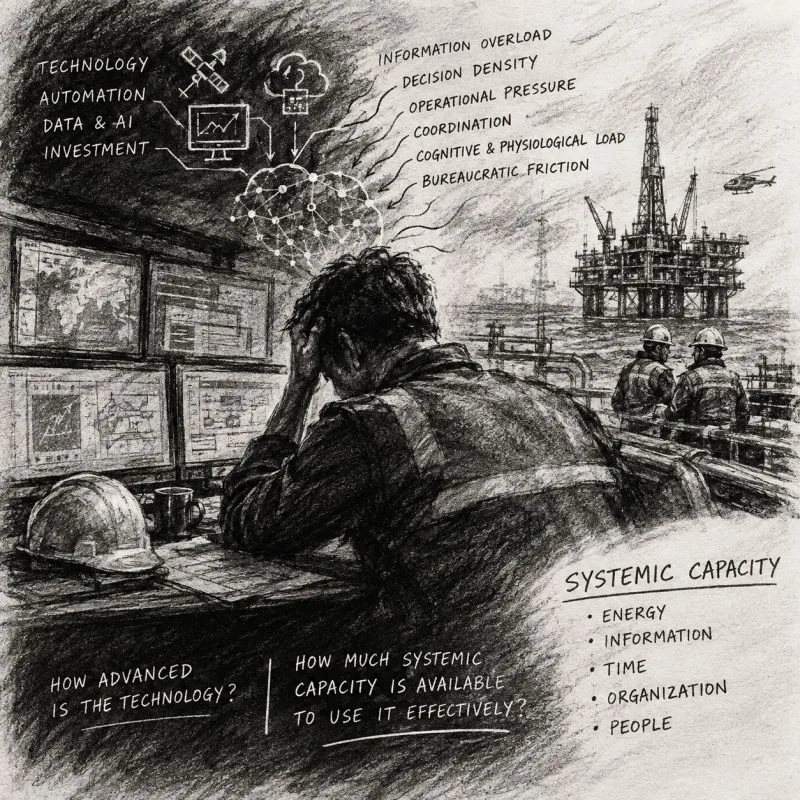
Why do highly engineered systems fail just when technology is most advanced?
In Oil & Gas and other complex operations, more technology does not guarantee better decisions: this piece examines systemic capacity, how much a system can absorb and turn into action under pressure.

NOTA-ECO-003 · Economy 5.0
Frankenstein and Oil: Why Does Venezuela Matter Geopolitically Again?
Third installment of the series: after tracing capital into AI and financial concentration, the next bottleneck comes into view, oil, and with it Venezuela returns to the geopolitical board.