

Economia 5.0 · OSF-ECO-140
Dossier 5 — Sistemi complessi: mercati, informatica e sistemi militari
Di Carlos J. Pérez Pulido · ISHEA Institute ·
Mercati, informatica ed eserciti letti come un'unica architettura: cedono quando lo scopo si allontana dal valore reale, la trasmissione si corrompe o manca resilienza. ISHEA come legge trasversale di stabilità.
Preprint — Manoscritto depositato su OSF. Senza revisione paritaria.
Opera originale in inglese.
This dossier analyzes markets, computing, and military systems as complex structures governed by the ISHEA–KTR–TACC–IHC model. It shows that markets collapse when Purpose (K) diverges from real value, computing fails when Transmission (T) is corrupted, and armies weaken when Resilience (R) is insufficient. Complex systems thus validate ISHEA as a transversal law of systemic stability.
⚙ Exp. 5– Complex Systems: Markets, Computing, and Military
Systems Validation of the ISHEA–KTR–TACC–IHC Model
Author: Carlos Pérez Pulido
Period: 20th–21st Century Case Studies
Overview
This dossier applies the ISHEA–KTR–TACC–IHC framework to complex systems beyond biology or society, focusing on three domains:
1. Markets, where speculation and purpose misalignment (K) lead to crises.
2. Computing systems, where transmission (T) failures generate breakdowns.
3. Military organizations, where resilience (R) determines survival and performance.
The analysis shows that systemic collapses in these domains follow the same K–T–R dynamics observed in health, ecology, and history.
Key Insights
- Markets:
- When Purpose (K) diverges from real value (speculation, bubbles), systems become unstable.
- Transmission (T) failures, such as misinformation or lack of transparency, increase volatility.
-
Crises emerge when Resilience (R) mechanisms (regulation, buffers) are insufficient.
-
Computing Systems:
- Fragility arises when Transmission (T) is corrupted (software bugs, network failures).
- Purpose (K) without security alignment creates systemic risk (cyberattacks, blackouts).
-
Resilience (R) depends on redundancy, modularity, and adaptive protocols.
-
Military Systems:
- Military resilience relies on morale, logistics, and redundancy.
- Collapse occurs when Purpose (K) is fragmented (unclear mission), Transmission (T) fails (command breakdown), or Resilience (R) is overwhelmed.
- Historical examples confirm that wars are won or lost on KTR alignment.
Hypotheses
- H24.1: Markets collapse when K (purpose) diverges from value, regardless of short-term growth.
- H24.2: Computing systems fail primarily through Transmission (T) breakdowns.
- H24.3: Military performance depends on R (resilience) but requires alignment with K and T.
Results (Conceptual Validation)
- Financial crises (2008, crypto bubbles) validate that markets collapse without coherent K.
- Major outages (cloud service crashes, cyber incidents) demonstrate the fragility of T in computing.
- Military case studies (Iraq 2003, Afghanistan 2021) confirm that armies fail when purpose erodes and communication collapses.
Conclusion
Complex systems validate the universality of ISHEA:
- Markets prove the danger of misaligned K.
- Computing illustrates the centrality of T.
- Military confirms the role of R.
Across domains, systemic collapse follows the same K–T–R cycle, reinforcing ISHEA as a transversal law of resilience and failure.
Suggested Files
- exp24_complex_systems.md
- exp24_complex_systems_dataset.csv
- exp24_complex_systems_analysis.py
- figures/exp24_markets_crisis.png
- figures/exp24_computing_failures.png
- figures/exp24_military_resilience.png
Nella stessa sala — Economia 5.0

NOTA-ECO-001 · Economia 5.0
E se le variabili con cui misuriamo il successo dei Paesi fossero del tutto capovolte?
Da decenni il progresso si misura con PIL, produttività, crescita ed energia. Questo testo sostiene che quelle variabili potrebbero essere capovolte e invita a ripensare che cosa significhi, per un Paese, prosperare.
NOTA-ECO-002 · Economia 5.0
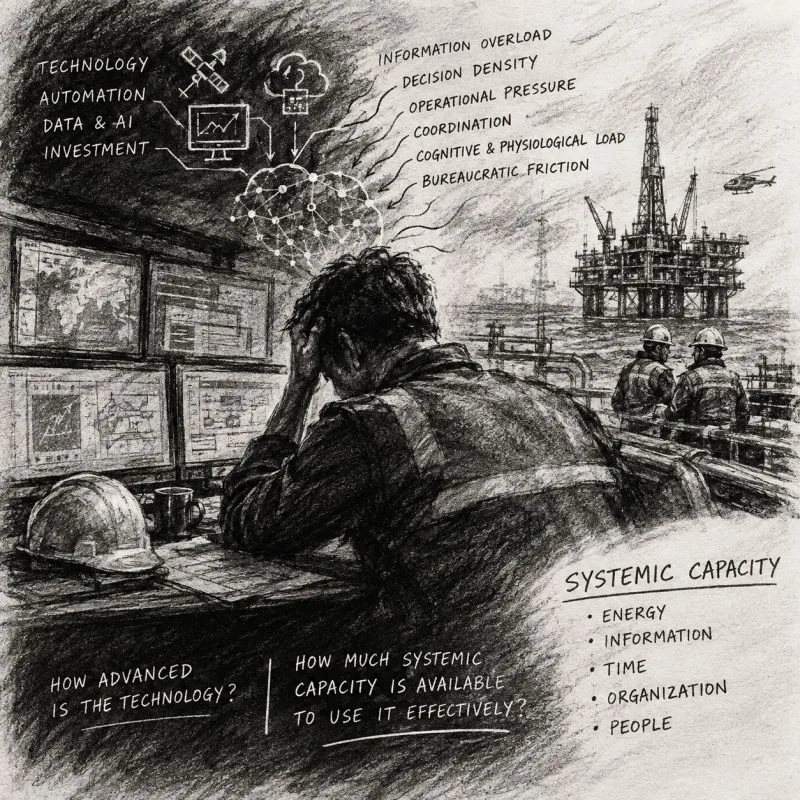
Perché l’alta ingegneria sbaglia proprio quando la tecnologia è più avanzata?
Nell’Oil & Gas e in altre operazioni complesse, più tecnologia non garantisce decisioni migliori: questo testo indaga la capacità sistemica, quanto un sistema sa assorbire e tradurre in azione sotto pressione.

NOTA-ECO-003 · Economia 5.0
Frankenstein e il petrolio: perché il Venezuela torna a contare nella geopolitica?
Terza puntata della serie: dopo il passaggio dal capitale all'IA e alla concentrazione finanziaria, emerge il nuovo collo di bottiglia, il petrolio, e con esso il Venezuela torna sullo scacchiere geopolitico.