

Economy 5.0 · NOTA-ECO-040
Venezuela's oil comeback: not a boom, a restart
By Carlos J. Pérez Pulido · ISHEA Institute ·
A 25% rise in Venezuelan oil output reads well on paper. The piece asks the harder question: not how much production grew, but why, and what that reveals about the country's real capacity.
Note — Short piece published openly. Thinking in progress, not a result.
Venezuela’s Oil Comeback: It’s not a boom. It’s a restart.
The recent ~25% increase in Venezuela’s oil production looks impressive on paper.
But the key question is not how much it grew — it’s why it grew.
Because the evidence points to something very different from a structural expansion.
This is not a wave of new capacity.
It is a system coming back online.
Three forces explain most of the rebound:
🔄 Reactivation of shut-in production
Idle wells and previously constrained fields being restarted.
🚢 Logistics unblocking
Storage constraints and export bottlenecks easing, allowing crude to actually leave the system.
🧪 Commercial normalization
Improved access to diluents and export channels enabling heavy crude to move again.
⚙️ Targeted operational support
Selective rehabilitation of existing infrastructure (including JV activity with international operators).
The distinction is critical:
Recovering suppressed capacity is not the same as creating new capacity.
One can happen in months.
The other takes years and billions in sustained investment.
So what we are seeing is not a structural oil boom.
It is an operational rebound of a stressed system returning toward equilibrium.
And that raises the real question:
👉 How much of this recovery is actually sustainable once the “idle capacity” is fully exhausted?
Because after the restart phase… growth becomes much harder.
#Venezuela #OilMarkets #Energy #OPEC #Macroeconomics #Geopolitics #EnergyTransition
In the same room — Economy 5.0

NOTA-ECO-001 · Economy 5.0
What if the variables we use to measure national success were completely backwards?
For decades, progress has been measured through GDP, productivity, growth and energy use. This piece argues those variables may be inverted and asks us to rethink what it means for a country to thrive.
NOTA-ECO-002 · Economy 5.0
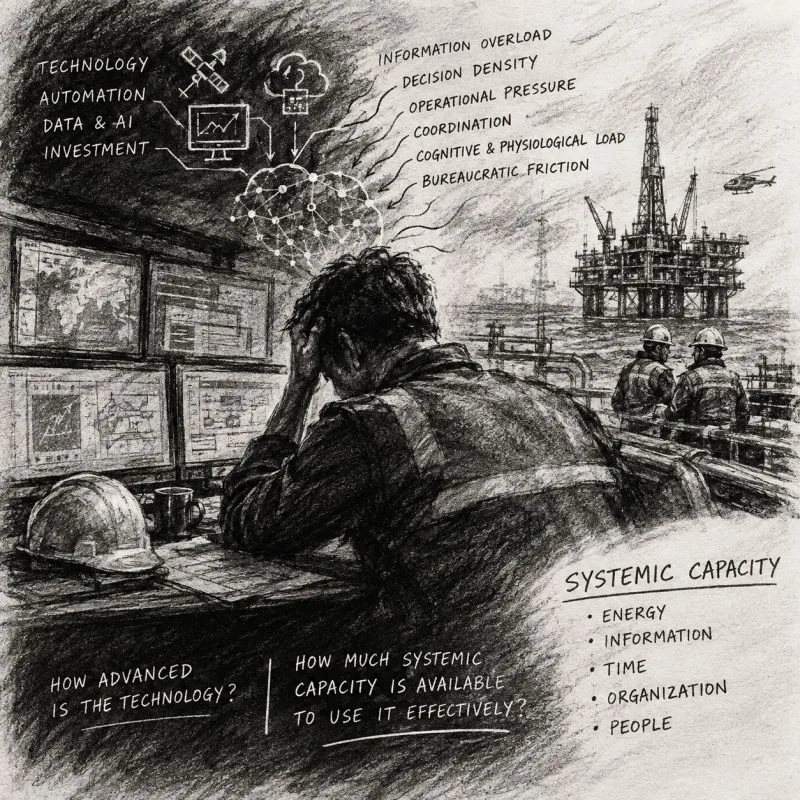
Why do highly engineered systems fail just when technology is most advanced?
In Oil & Gas and other complex operations, more technology does not guarantee better decisions: this piece examines systemic capacity, how much a system can absorb and turn into action under pressure.

NOTA-ECO-003 · Economy 5.0
Frankenstein and Oil: Why Does Venezuela Matter Geopolitically Again?
Third installment of the series: after tracing capital into AI and financial concentration, the next bottleneck comes into view, oil, and with it Venezuela returns to the geopolitical board.