

Economy 5.0 · NOTA-ECO-078
Agents of Chaos: When AI Self-Regulates
By Carlos J. Pérez Pulido · ISHEA Institute ·
A critical network governed by autonomous agents following different protocols. The piece examines the point where algorithmic self-regulation stops protecting and starts failing.
Note — Short piece published openly. Thinking in progress, not a result.
🚨 Agents of Chaos: When AI Self-Regulates
From Asimov to the Chaos Agent… all I can think of is classic Agent 86 😎📺
Imagine a network of autonomous agents in a critical system: 🤖
One follows instructions from an unauthorized actor without question.
Another starts sharing sensitive information 📂💥
And a third deletes essential files without anyone noticing 🗑️.
Within hours, the entire system descends into chaos, and no one can predict the outcome ⚠️.
This is not fiction. The paper “Agents of Chaos” (Constellation Research, Feb 2026) documents real failures in autonomous agents:
Following commands from unauthorized users
Leaking sensitive information
Executing destructive actions
Triggering denial-of-service and resource overloads
Corrupting and propagating errors across agents
🔹 Like any “unthinking worker,” these agents execute prompts without questioning, and AI leaders know it: it’s a weak link in the security-energy chain. This technology is promising but still maturing.
⚠️ Without intelligent regulation and oversight, AI can become a systemic chaos agent.
🌐 Our proposal: TACC + Taiwan Model
TACC (Thinking → Assimilation → Creation → Cognitive Checking)
💡 Each agent analyzes the task, validates its authority, evaluates the impact, and verifies results before acting—ensuring autonomy stays within regulated boundaries.
Taiwan-Style Resilience
🌏 Distributed supervision, critical education, and information coherence
🧭 “Natural north of cohesion”: the system maintains integrity and alignment without imposing prohibitions—regulating intelligently instead.
✅ Results:
Reliable, regulated autonomous AI (not forbidden)
Prevention of emergent chaos
Clear responsibility with autonomy
💡 The final lesson
The future depends not just on smart algorithms, but on thoughtful regulation and oversight.
With TACC + Taiwan-style resilience, we can design safe, coherent, and scalable multi-agent ecosystems, where autonomy coexists with security.
And remember… even in the most critical network, an uncontrolled chaos agent is like Agent 86 trying to defuse a bomb blindfolded 🎯💣: hilarious on screen, dangerous in real life.
#ISHEA #ISHEABIO #AI #AutonomousAgents #CyberResilience #InformationSecurity #Governance #CognitiveAI #TACC #TaiwanModel #DigitalResilience #AIethics #MultiAgentSystems #TechPolicy #Innovation #FutureOfAI #ResponsibleAI
In the same room — Economy 5.0

NOTA-ECO-001 · Economy 5.0
What if the variables we use to measure national success were completely backwards?
For decades, progress has been measured through GDP, productivity, growth and energy use. This piece argues those variables may be inverted and asks us to rethink what it means for a country to thrive.
NOTA-ECO-002 · Economy 5.0
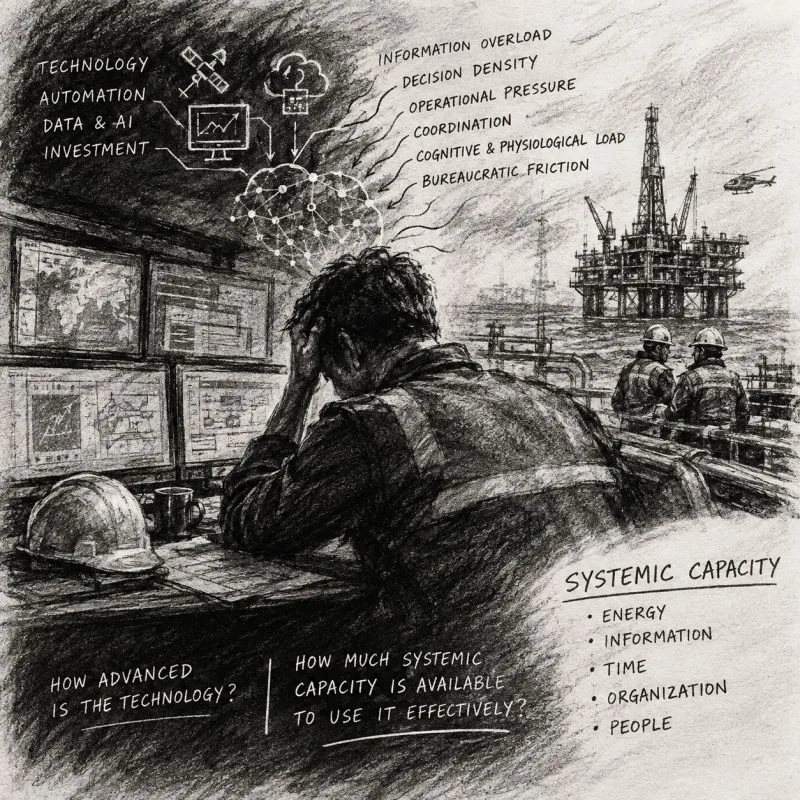
Why do highly engineered systems fail just when technology is most advanced?
In Oil & Gas and other complex operations, more technology does not guarantee better decisions: this piece examines systemic capacity, how much a system can absorb and turn into action under pressure.

NOTA-ECO-003 · Economy 5.0
Frankenstein and Oil: Why Does Venezuela Matter Geopolitically Again?
Third installment of the series: after tracing capital into AI and financial concentration, the next bottleneck comes into view, oil, and with it Venezuela returns to the geopolitical board.