

Economy 5.0 · NOTA-ECO-001
What if the variables we use to measure national success were completely backwards?
By Carlos J. Pérez Pulido · ISHEA Institute ·
For decades, progress has been measured through GDP, productivity, growth and energy use. This piece argues those variables may be inverted and asks us to rethink what it means for a country to thrive.
Note — Short piece published openly. Thinking in progress, not a result.
Original piece in Spanish.
📊 ¿Y si las variables con las que medimos el éxito de los países estuvieran completamente al revés? 📉🌍
Durante décadas hemos medido el progreso mediante GDP, productivity, economic growth, energy consumption and carbon emissions.
Son importantes. Pero medimos muy bien lo que un sistema produce y consume, y mucho menos el costo de mantener ese desempeño.
Pensemos en tres ejemplos.
Una fábrica aumenta su producción 20%.
Parece una mejora. Pero necesita más energy, overtime, maintenance, coordination and human effort.
¿Es realmente más eficiente?
Un accidente laboral puede dejar intacta la cifra de producción, mientras genera medical costs, lost working time, operational disruption and human suffering.
¿Dónde queda registrado todo ese costo sistémico?
Una empresa tala un bosque y la madera entra en la economía como producción.
Pero también pueden perderse carbon storage, biodiversity, soil protection, water regulation and ecological resilience.
La madera tiene un precio. ¿Lo tiene todo lo que el ecosistema perdió?
Esta es la pregunta detrás de Economy 5.0.
En lugar de preguntar únicamente:
«How much does the system produce?»
debemos preguntar:
«What does the system have to spend — and what does it have to lose — to remain capable of producing it?»
Aquí entra Systemic Coherence.
La eficiencia no es simplemente producir más. La sostenibilidad no es únicamente reducir carbono.
La cuestión es:
¿Puede un sistema maintain its function, adapt, recover and reorganize without continuously increasing its internal cost or degrading the systems that support it?
No propongo sustituir GDP, productivity or carbon metrics.
Propongo examinar qué dejan fuera.
Ese es el punto de partida de:
Economy 5.0: Beyond Energy and Carbon — Toward Systemic Coherence.
🔬 C.J. Pérez Pulido
Director of Research, ISHEA Institute
#Economy50 #Economy5_0 #ISHEA #SystemicCoherence #EconomicSystems #Sustainability #EnergySystems #ComplexSystems #HumanResilience
In the same room — Economy 5.0
NOTA-ECO-002 · Economy 5.0
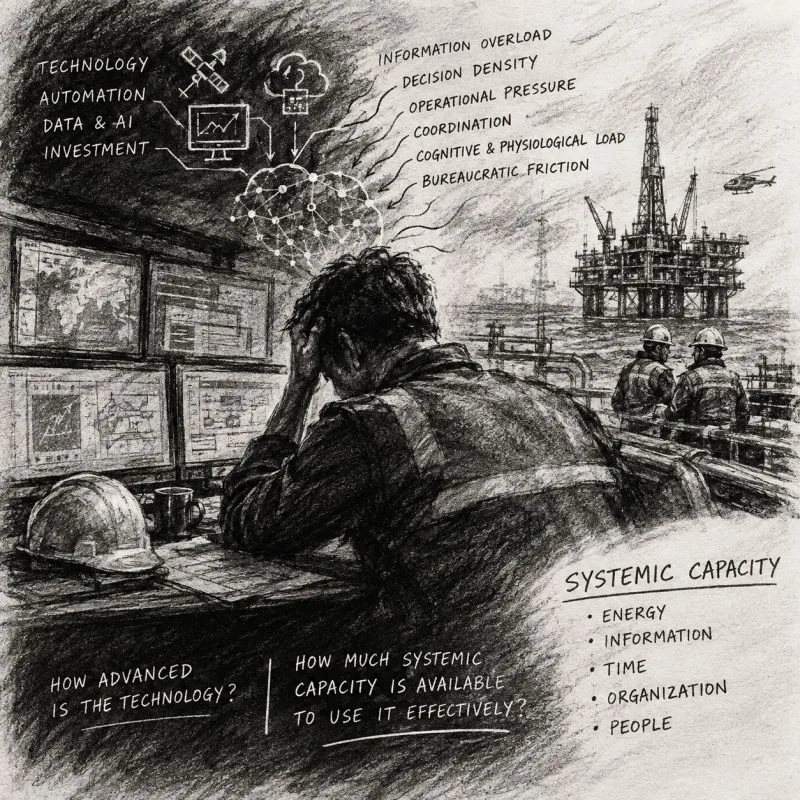
Why do highly engineered systems fail just when technology is most advanced?
In Oil & Gas and other complex operations, more technology does not guarantee better decisions: this piece examines systemic capacity, how much a system can absorb and turn into action under pressure.

NOTA-ECO-003 · Economy 5.0
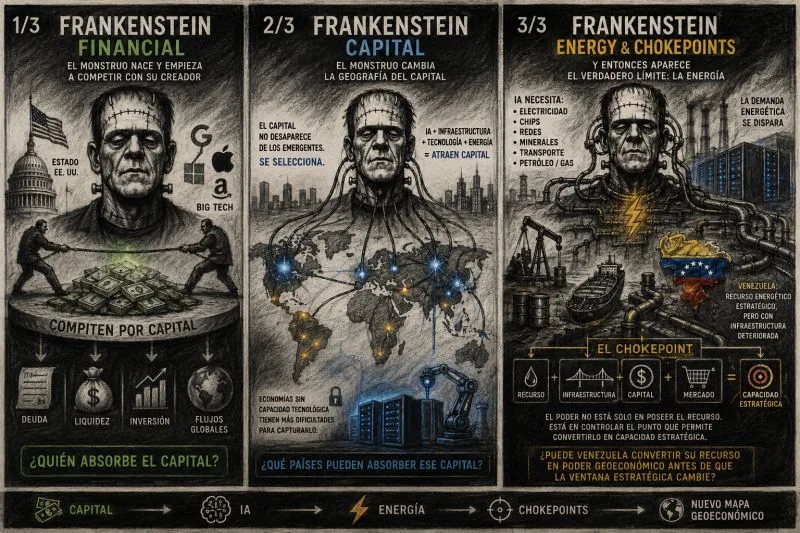
Frankenstein and Oil: Why Does Venezuela Matter Geopolitically Again?
Third installment of the series: after tracing capital into AI and financial concentration, the next bottleneck comes into view, oil, and with it Venezuela returns to the geopolitical board.
NOTA-ECO-004 · Economy 5.0
The Financial Frankenstein (2/3): The New Geography of Capital
Second of three parts: the State built the ecosystem that gave birth to Big Tech, and now the creature competes with its creator and redraws the world map of capital.