

Bioenergetics · OSF-BIO-089
Empirical evidence of energy-driven peptide formation under interplanetary conditions
By Carlos J. Pérez Pulido · ISHEA Institute ·
Peptides form from glycine under directed energy in interplanetary-like conditions: an empirical case of the universal Δ±1 coherence principle the ISHEA Institute traces across disciplines.
Preprint — Manuscript deposited on OSF. Not peer-reviewed.

Español:
Explora la evidencia convergente de un principio de coherencia universal (Δ±1) que organiza sistemas energéticos desde turbulencias fluidas hasta plasmas astrofísicos y redes neuronales. Este enfoque interdisciplinario del ISHEA Institute conecta bioenergética, física y teoría de sistemas complejos, proporcionando un marco para entender cómo estructuras coherentes locales gobiernan la dinámica global de los sistemas.
Inglés:
Exploring convergent evidence for a universal coherence principle (Δ±1) governing energetic systems from fluid turbulence to astrophysical plasmas and neural networks. This interdisciplinary approach from the ISHEA Institute bridges bioenergetics, physics, and complex systems theory, providing a framework for understanding how localized coherent structures govern global system dynamics.
Energy Coupling Universe (ECU) and Peptide Formation Experiments
The Energy Coupling Universe (ECU) is a theoretical framework proposed by Carlos J. Pérez Pulido at the ISHEA Institute, suggesting that coherent energy in the universe can drive self-organization across multiple scales, from molecular structures to complex bioenergetic and cognitive systems. The ECU framework is closely associated with the ISHEA Δ±1 principle, which models energetic systems as composed of localized coherence nodes (Δ+1) embedded within dissipative environments (Δ−1).
Background
The ECU framework proposes that energy in natural systems is not solely dispersive but can actively organize matter and information. It integrates concepts from biophysics, prebiotic chemistry, and complex systems theory to provide a unified perspective on structural and energetic organization across scales.
Empirical Proof: Peptide Formation Under Interplanetary Conditions
To provide experimental support for the ECU framework, studies have examined the formation of simple peptides from glycine under conditions simulating interplanetary environments. These experiments aim to demonstrate that directed energy, such as simulated cosmic rays and solar wind, can induce molecular self-organization.
Experimental Design
Objective: Assess whether high-energy particle irradiation can drive peptide formation from glycine in ultra-high vacuum and low-temperature conditions.
Materials: Glycine (standard and partially deuterated), ultra-high vacuum chambers, cryogenic cooling systems, high-energy proton sources.
Methods: Glycine samples were exposed to high-energy protons under ultra-high vacuum (≤10^-9 Torr) and cryogenic temperatures (10–100 K). Formation of dipeptides and water byproducts was monitored using infrared spectroscopy and mass spectrometry. Deuterated glycine was used to trace condensation reactions. Experiments were conducted in independent chambers with multiple replicates to ensure reproducibility.
Replication: Multiple independent runs (n=5) were performed in chambers named ICA and AQUILA.
Results
Dipeptide formation (e.g., glycylglycine) was observed, indicating molecular self-organization induced by directed energy.
Isotopic analysis confirmed water formation via condensation reactions between glycine molecules.
Molecular complexity increased significantly even under ultra-high vacuum and low temperatures, simulating interstellar medium conditions.
Interpretation
These findings support the hypothesis that coherent energy can act as a universal organizing factor, promoting the emergence of order and complexity. The results align with the ECU framework and the Δ±1 principle, suggesting that energy can concentrate coherence in localized nodes across physical, chemical, and biological systems.
Implications
Provides experimental evidence for energy-driven molecular self-organization in prebiotic conditions.
Supports theoretical models of cross-scale coherence in complex systems.
Offers a potential framework for understanding bioenergetic processes and cognitive systems as emergent phenomena governed by energy coupling.
References
-
Hopkinson, A.T. et al., Amino acid energetic processing leading to extraterrestrial peptides, Astronomy, Chemistry, and Physics, 2026.
-
Ioppolo, S. et al., A non-energetic mechanism for glycine formation in the interstellar medium, Nature Astronomy, 2021.
-
Hadraoui, K. et al., Distributed glycine in comet 67P/Churyumov-Gerasimenko, Astron. Astrophys., 2019.
-
Muñoz-Caro, G. et al., Amino acids from ultraviolet irradiation of interstellar ice analogues, Nature, 2002.
-
Bernstein, M. et al., Racemic amino acids from UV photolysis of interstellar ice analogues, Nature, 2002.
-
Maté, B. et al., Stability of extraterrestrial glycine under energetic particle radiation, Astrophys. J., 2015.
See also
ISHEA Δ±1 framework
Bioenergetics
Prebiotic chemistry
Molecular self-organization
Cosmic rays
Complex systems
-
In the same room — Bioenergetics

OSF-BIO-001 · Bioenergetics
Milestone Report: From Nature Conference Poster to the Two-Level Bioenergetic Coherence Model
Technical report and visual archive tracing one year of the ISHEA Δ±1 framework: from a 2025 Nature Conference poster in South Korea to its computational formalization with NAD+, ROS and ATP.
OSF-BIO-002 · Bioenergetics
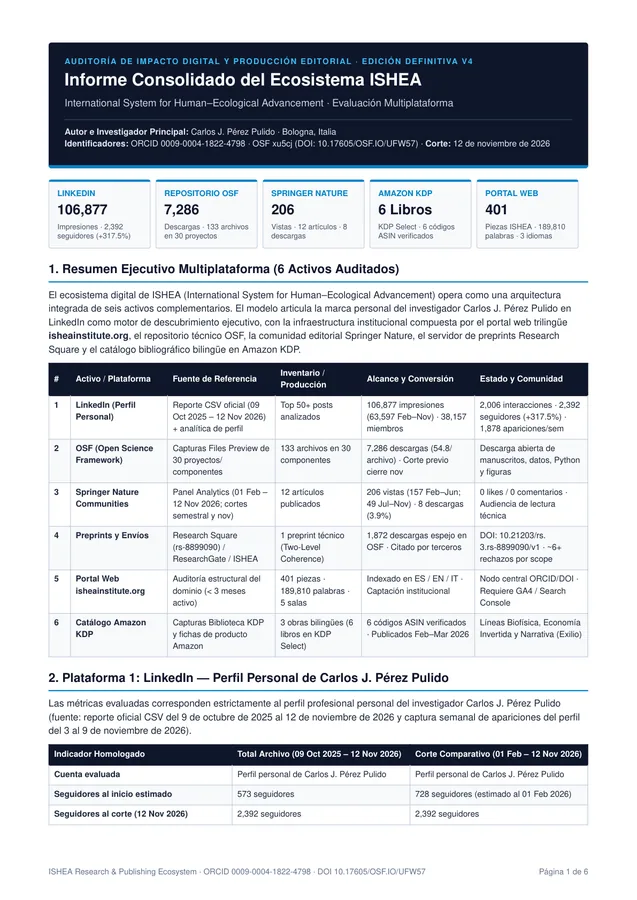
Multiplatform Performance Audit and Ecosystem Maturity Benchmark of ISHEA (2025–2026)
Report v4.1 measuring the reach of six ISHEA dissemination channels, from LinkedIn to OSF, with 106,877 impressions and 7,286 downloads. It shows how far its open-science infrastructure has matured.

NOTA-BIO-003 · Bioenergetics
The Nobel, optogenetics and a question I want to test
Carlos J. Pérez Pulido reflects on the 2026 Nobel Prize in Physiology or Medicine, awarded to Deisseroth, Hegemann and Nagel for optogenetics, and poses a question he intends to put to the test.