

Planetary systems · OSF-PLA-012
Planetary energy flows and their correlation with the solar Gleissberg cycle
By Carlos J. Pérez Pulido · ISHEA Institute ·
A 1998–2024 dataset joining NOAA proton flux, solar indices and the South Atlantic Anomaly to quantify how solar activity redistributes planetary energy and disturbs the geomagnetic field.
Preprint — Manuscript deposited on OSF. Not peer-reviewed.
This dataset and accompanying analysis document the systemic planetary energy fluctuations observed from 1998–2024, integrating NOAA satellite proton flux measurements, solar indices (F10.7 flux, sunspot numbers), and geomagnetic anomalies including the South Atlantic Anomaly (SAA). Using the ISHEA framework, we identify and quantify events, revealing nonlinear interactions between solar activity, planetary energy redistribution, and geomagnetic disturbances. This resource enables further research into planetary bioenergetic coupling, systemic sensitivity to solar events, and the predictive modeling of geomagnetic impacts.
Wiki / Notes:
Objective: To analyze planetary energy flows and their correlation with the Gleissberg Solar Cycle using satellite and geomagnetic datasets.
Methods:
Satellite Data: NOAA-15 & NOAA-19 proton flux (>35, >70, >140 MeV), 1998–2024
Solar Indices: F10.7 cm flux, sunspot numbers
Geomagnetic Parameters: SAA area and drift, Dst indices during geomagnetic storms
Analysis: Correlation matrices, time series analysis, sensitivity evaluation
Key Findings:
Proton flux peaks correspond to solar maxima in the Gleissberg Cycle.
Geomagnetic anomalies, including SAA area fluctuations, show measurable responses to solar activity.
Planetary energy flows are non-linear and show systemic coherence patterns.
Applications:
Understanding planetary and biological energy interactions
Risk assessment for geomagnetic storms
Support for research on climate and energy flow management
Files Included:
Scientific validation document (PDF)
Supplementary figures (S1, S2, S3)
CSV dataset of satellite and geomagnetic parameters
References: Adams et al., 2025; Bregou et al., 2022; Feynman & Ruzmaikin, 2014; Spaceweather Archive, 2025
In the same room — Planetary systems
NOTA-PLA-001 · Planetary systems
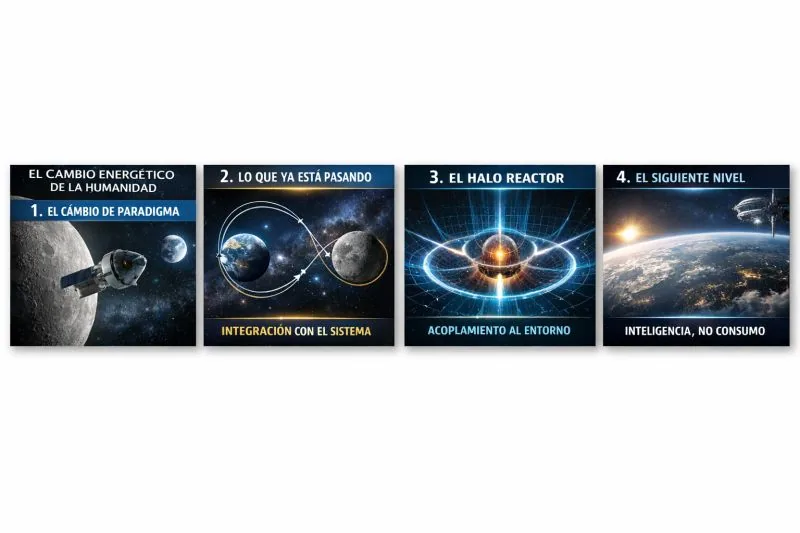
3/4. The HALO Reactor Is Not a Reactor
Third instalment of the series: the HALO Reactor neither burns nor consumes fuel. The piece dismantles the classic idea of a reactor to describe a system that organises energy rather than spending it.
NOTA-PLA-002 · Planetary systems
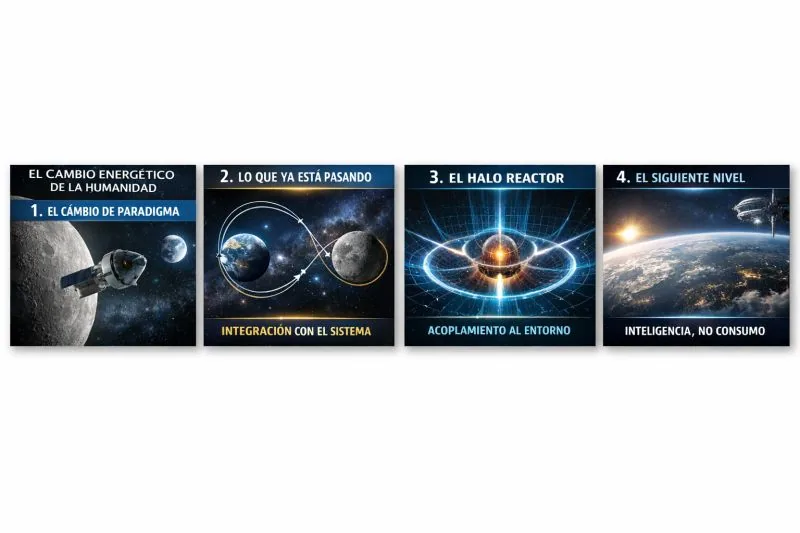
Coherent Energy: From Artemis to HALO
Not a story about rockets, but about the invisible principle nature uses to sustain complex systems, and which is now redefining how missions and machines are designed.
SN-PLA-003 · Planetary systems
Integrating planetary energy flows, solar cycles and biosystem dynamics
The Planetary Energy Flow Index links solar cycles, stratospheric chemistry and bioenergetics inside the HALO framework, offering a reproducible bridge between planetary and biological science