

Economy 5.0 · OSF-ECO-149
K-Model: a modular open-science framework for complex systems
By Carlos J. Pérez Pulido · ISHEA Institute ·
A modular open-science framework for analysing and anticipating the behaviour of complex systems: it integrates the TACC–ICC circuit and the LEX subsystems over a panel of some 150 countries, 2015–2024.
Preprint — Manuscript deposited on OSF. Not peer-reviewed.
Original piece in Spanish.
K Model es un marco modular de ciencia abierta para analizar y anticipar el comportamiento de sistemas complejos (economía, sociedad, instituciones, salud, reputación, legal y gobernanza). Integra el circuito TACC–ICC (ICC := TACC) y el marco KTR con subsistemas LEX (p. ej., LEXFIN, LEXSALUTE, LEXHR/HSE, LEXGOV, LEXPOL, LEXKEY, LEXEMPRESAS, LEXAVERY, LEXESTATE). Trabaja con un panel global (~150 países, 2015–2024) y métodos reproducibles (ETL, PCA/SEM, OLS/Ridge/Lasso, sensibilidad Sobol/Monte Carlo), más dashboards y casos de estudio sectoriales.
Licencias: Contenido CC BY-NC 4.0, Código MIT, Datos CC0 (informe breve ARR). Contacto: ISHEAInstitute.org@gmail.com.
Descripción (dos párrafos, un poco más amplia)
K Model unifica variables estructurales, cognitivas y de gobernanza bajo un marco epistémico común (ISHEATACC–ICC + KTR) y una arquitectura LEX que permite evaluar finanzas, salud, capital humano y HSE, política/ley, gobernanza, reputación corporativa, contenido y mercado inmobiliario (entre otros). Además de GCSI2 v2.3 y LEXESTATE v0.1, el proyecto incluye líneas de trabajo en riesgo sistémico, narrativa/viralidad, alineamiento institucional, y diseño de políticas basadas en evidencia.
La base empírica cubre ~150 países (2015–2024) con ETL reproducible y modelos validados (PCA/SEM, regresiones OLS/Ridge/Lasso, pruebas de sensibilidad). Se entregan datasets y scripts para replicación, junto con dashboards y anexos técnicos. Licenciamiento diferenciado: Contenido CC BY-NC 4.0, Código MIT, Datos CC0, e informe breve ARR para registro de autoría.
Etiquetas sugeridas
K-Model, TACC-ICC, KTR, LEX, Resiliencia Sistémica, OSF, PCA, Ridge/Lasso, Sobol, Open Science
In the same room — Economy 5.0

NOTA-ECO-001 · Economy 5.0
What if the variables we use to measure national success were completely backwards?
For decades, progress has been measured through GDP, productivity, growth and energy use. This piece argues those variables may be inverted and asks us to rethink what it means for a country to thrive.
NOTA-ECO-002 · Economy 5.0
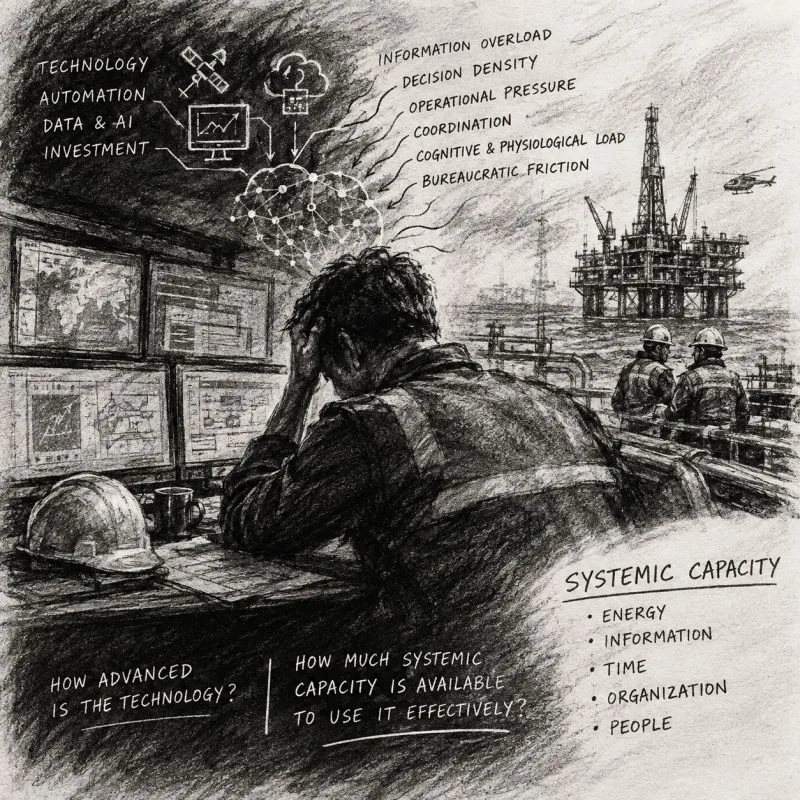
Why do highly engineered systems fail just when technology is most advanced?
In Oil & Gas and other complex operations, more technology does not guarantee better decisions: this piece examines systemic capacity, how much a system can absorb and turn into action under pressure.

NOTA-ECO-003 · Economy 5.0
Frankenstein and Oil: Why Does Venezuela Matter Geopolitically Again?
Third installment of the series: after tracing capital into AI and financial concentration, the next bottleneck comes into view, oil, and with it Venezuela returns to the geopolitical board.