

Economy 5.0 · OSF-ECO-148
Principle Plus One (+1): zero as a threshold of renewal
By Carlos J. Pérez Pulido · ISHEA Institute ·
A universal rule of systemic transition: every closure or entropy point opens a further cycle. Integrated into the ISHEA Index, the ICC and the K-Model, it reads resilience as regeneration.
Preprint — Manuscript deposited on OSF. Not peer-reviewed.
The Principle Plus 1 (+1) establishes a universal rule of systemic transition: zero is never an endpoint but a threshold of renewal. Rooted in cognitive, ecological, and social sciences, it formalizes the idea that every closure, entropy point, or apparent end activates a subsequent cycle (+1), ensuring continuity across human, ecological, and cognitive processes.
This principle provides a unifying lens for resilience: energy, knowledge, and cooperation are never extinguished but reconfigured. Integrated within the ISHEA Index, the ICC (Cognitive Cohesion Index), and the K Model, it reinforces that human flourishing, sustainability, and systemic adaptation follow a regenerative law of transition applicable to biology, economy, and collective life.
In the same room — Economy 5.0

NOTA-ECO-001 · Economy 5.0
What if the variables we use to measure national success were completely backwards?
For decades, progress has been measured through GDP, productivity, growth and energy use. This piece argues those variables may be inverted and asks us to rethink what it means for a country to thrive.
NOTA-ECO-002 · Economy 5.0
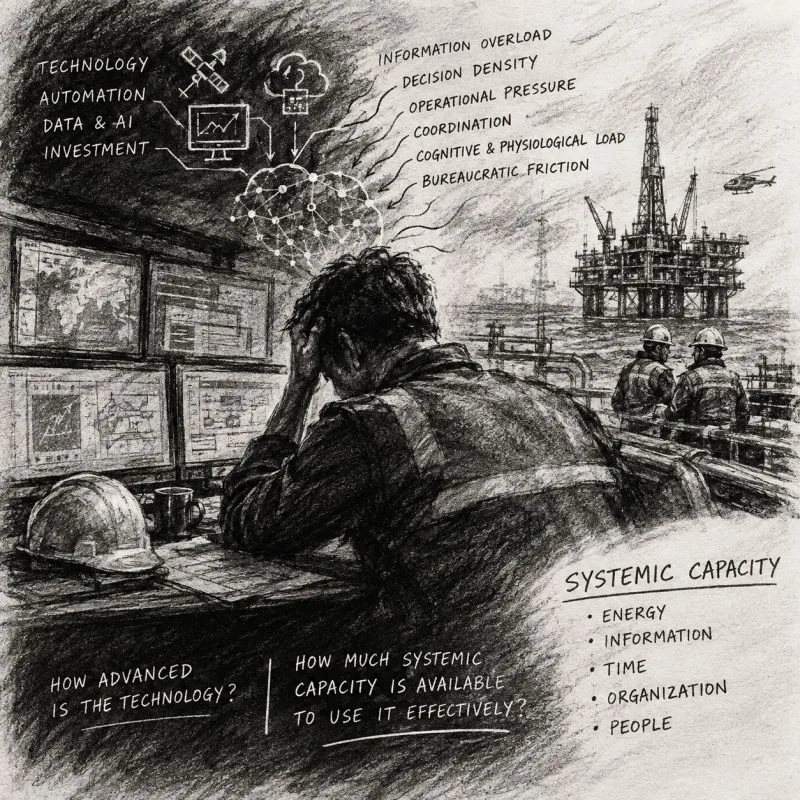
Why do highly engineered systems fail just when technology is most advanced?
In Oil & Gas and other complex operations, more technology does not guarantee better decisions: this piece examines systemic capacity, how much a system can absorb and turn into action under pressure.
NOTA-ECO-003 · Economy 5.0
Frankenstein and Oil: Why Does Venezuela Matter Geopolitically Again?
Third installment of the series: after tracing capital into AI and financial concentration, the next bottleneck comes into view, oil, and with it Venezuela returns to the geopolitical board.