

Economy 5.0 · NOTA-ECO-087
Venezuela: From Political Storm to Ecological Challenge
By Carlos J. Pérez Pulido · ISHEA Institute ·
An analysis of the structural barrier holding back investment in Venezuela: not only politics and sanctions, but an environmental liability that conditions any economic reconstruction.
Note — Short piece published openly. Thinking in progress, not a result.
🇻🇪 #Venezuela: From Political Storm to Ecological Challenge
Source: Bloomberg Línea
Venezuela faces a structural barrier to investment — not only due to political and sanctions-related factors, but also because of managerial, environmental, and reputational risk.
Yet every systemic crisis has two sides.
📉 Causes and Consequences
Regulatory uncertainty and weak environmental institutions
Reputational risk for international investors
Lack of verifiable ESG standards
Result: less capital → lower production → higher systemic fragility.
Strategic projects remain stalled, financing costs rise, sustainable investment is excluded, and structural trust erodes.
🌱 The Other Side: Opportunity
Fixing isolated problems does not save an economy.
Protecting long-term productive capacity does.
Venezuela holds exceptional natural resources, real energy potential, and the capacity for productive reconversion. With verifiable environmental governance, clear metrics, and operational transparency, the country could turn risk into competitive advantage — accessing green finance, ESG capital, and modernizing production sustainably.
🚀 Strategic Pathways
Integrate real ESG criteria (not cosmetic compliance)
Reduce managerial risk through clear, stable rules
Use ecological transition as a productive lever
Rebuild trust through coherence, data, and systemic governance
🔚 Closing — ISHEA Perspective
Capital does not flee risk.
It flees improvisation.
From an ISHEA systemic view, resilience emerges when a system can self-organize and align energy flows, trust, and regulation. An ecological transition integrated with governance and transparency is not an ideological choice — it is a strategic opportunity to attract responsible capital, rebuild stability, and generate adaptive capacity.
The key is to allow talent, capital, and resources to flow coherently toward sustainable outcomes — protecting the goose that lays the golden eggs and ensuring long-term production.
#VenezuelaPower #GreenFinance #ESG #ReputationalRisk #SystemsThinking
#SystemicEconomics #Resilience #ISHEA #Kmodel
In the same room — Economy 5.0

NOTA-ECO-001 · Economy 5.0
What if the variables we use to measure national success were completely backwards?
For decades, progress has been measured through GDP, productivity, growth and energy use. This piece argues those variables may be inverted and asks us to rethink what it means for a country to thrive.
NOTA-ECO-002 · Economy 5.0
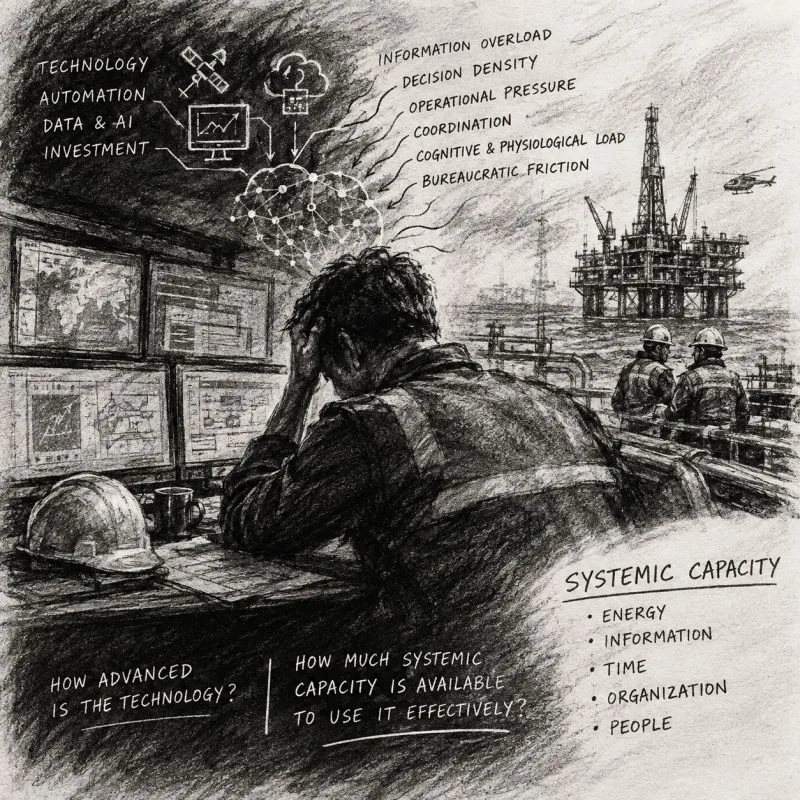
Why do highly engineered systems fail just when technology is most advanced?
In Oil & Gas and other complex operations, more technology does not guarantee better decisions: this piece examines systemic capacity, how much a system can absorb and turn into action under pressure.
NOTA-ECO-003 · Economy 5.0
Frankenstein and Oil: Why Does Venezuela Matter Geopolitically Again?
Third installment of the series: after tracing capital into AI and financial concentration, the next bottleneck comes into view, oil, and with it Venezuela returns to the geopolitical board.