

Economy 5.0 · NOTA-ECO-088
Jobless Growth 2025: It's Not a Lack of Jobs, It's an Economy in Transition
By Carlos J. Pérez Pulido · ISHEA Institute ·
GDP grows near 5% while formal job creation stays historically weak. The piece argues that this paradox signals no shortage of work, but an economy undergoing a structural transition.
Note — Short piece published openly. Thinking in progress, not a result.
📊 JOBLESS GROWTH 2025: IT’S NOT A LACK OF JOBS, IT’S AN ECONOMY IN TRANSITION
In 2025 we observed an apparent paradox:
📈 GDP growing near 5%
📉 Formal job creation historically weak
The mainstream explanation points to AI and productivity gains.
My conclusion is different (and perhaps more uncomfortable):
👉 The problem is not the absence of work, but a partially invisible economy.
In a working paper published by ISHEA Institute, I show that 45–55% of the labor gap can be explained by a digital economy that escapes traditional metrics:
Fragmented self-employment
Platform work & the creator economy
Cross-border freelancing
Digital goods and services production
Intangible consumption (Gen Z: services, experiences, subscriptions)
Jobs are not disappearing.
👉 They are redistributed, fragmented, and temporarily externalized, while 20th-century metrics try to measure a 21st-century economy.
📌 Key takeaway
We are not witnessing the end of employment, but a phase of economic transition in which new forms of work are being gradually and asymmetrically absorbed by statistical, fiscal, and institutional systems.
AI matters, yes.
But the real gap is structural and statistical, not productive.
🔍 Rethinking how we measure jobs and economic growth is no longer optional: it’s a precondition for designing realistic economic policies.
—
Carlos Pérez Pulido
ISHEA Institute – Economía 5.0
#JoblessGrowth #DigitalEconomy #FutureOfWork #AI #Macroeconomics #ISHEA #Policy #Economy5_0 #kmodel
In the same room — Economy 5.0

NOTA-ECO-001 · Economy 5.0
What if the variables we use to measure national success were completely backwards?
For decades, progress has been measured through GDP, productivity, growth and energy use. This piece argues those variables may be inverted and asks us to rethink what it means for a country to thrive.
NOTA-ECO-002 · Economy 5.0
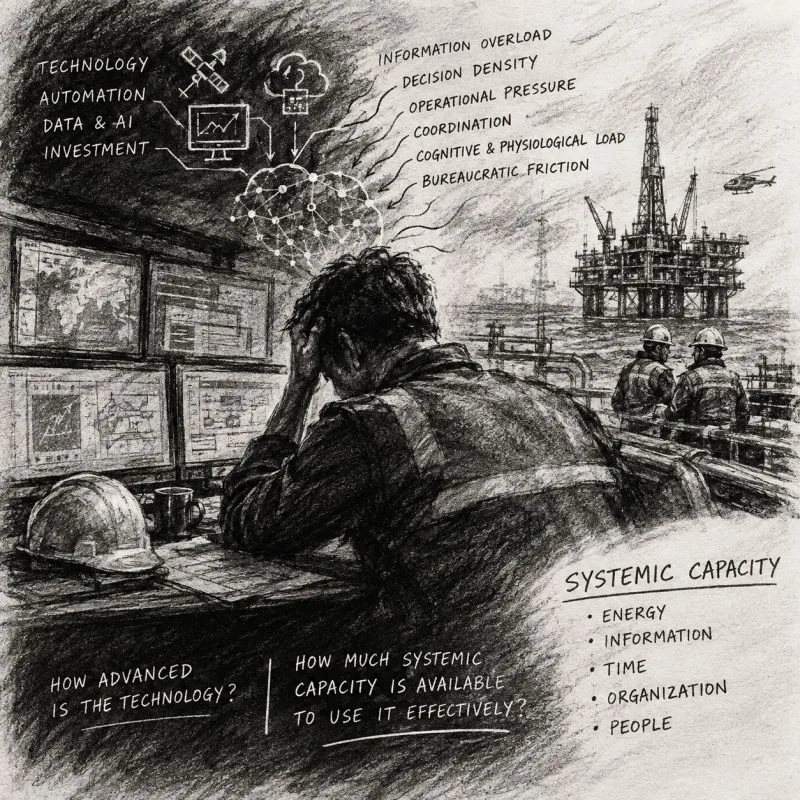
Why do highly engineered systems fail just when technology is most advanced?
In Oil & Gas and other complex operations, more technology does not guarantee better decisions: this piece examines systemic capacity, how much a system can absorb and turn into action under pressure.

NOTA-ECO-003 · Economy 5.0
Frankenstein and Oil: Why Does Venezuela Matter Geopolitically Again?
Third installment of the series: after tracing capital into AI and financial concentration, the next bottleneck comes into view, oil, and with it Venezuela returns to the geopolitical board.