

Collective cognition · NOTA-COG-026
Wreck-It Policy: A Caricature as a Map of Systemic Tension
By Carlos J. Pérez Pulido · ISHEA Institute ·
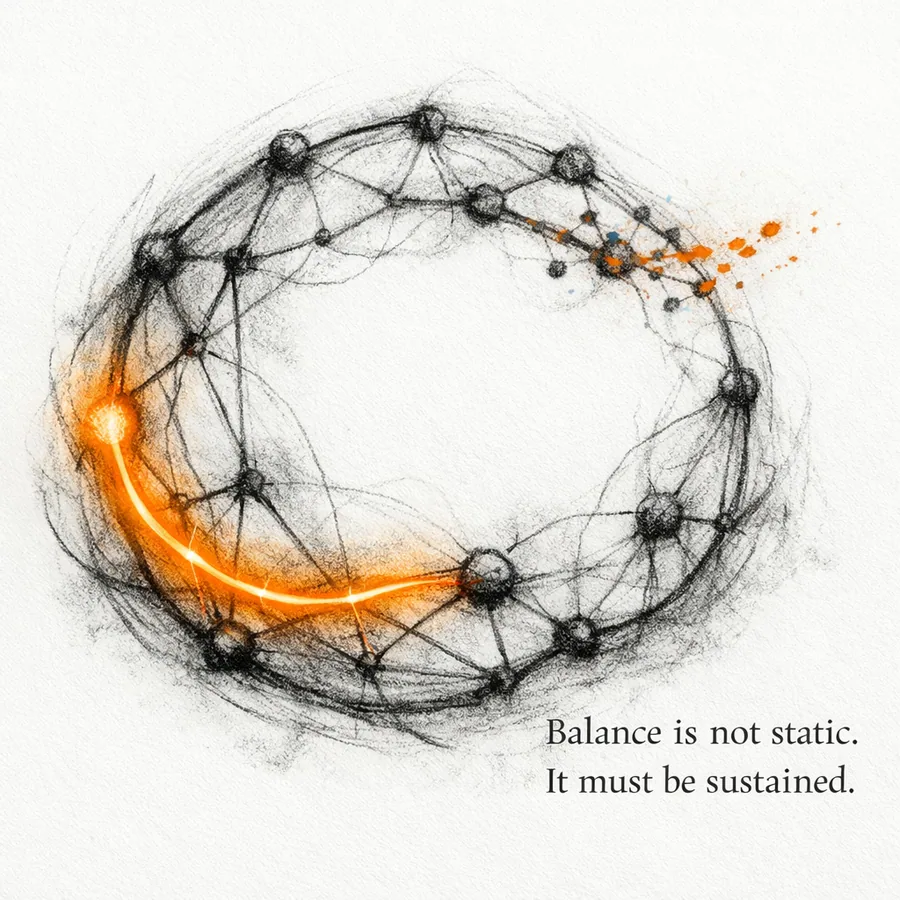
A caricature that pits geopolitical urgency against institutional coherence. Beneath the satire lies a diagnosis: the international order now faces hybrid actors its rules were never written for.
Note — Short piece published openly. Thinking in progress, not a result.
🧨 WRECK-IT POLICY
Geopolitical urgency vs. institutional coherence
This caricature is not just satire.
It is a map of real systemic tension.
Today's international system is confronting hybrid actors —
captured states, transnational crime, and terrorist networks —
that do not fit the rules designed in 1945.
When:
• the UN cannot sanction cartels,
• the ICC cannot prosecute organized crime,
• and governments shield illicit actors,
what emerges is Wreck-It Policy:
fast, unilateral, high-force action against immediate threats.
⚡ Short-term effectiveness:
• Disrupts criminal networks
• Freezes illicit assets
• Reduces localized violence
⚠️ Long-term entropic debt:
• Trust erosion
• Institutional weakening
• Normalization of unilateralism
🧠 ISHEA insight:
This is not ideology.
It is a systemic trade-off: speed vs. coherence.
The real question is not whether we like it.
It's whether we can afford NOT to —
and what happens when the bill comes due.
👉 Full analysis and sources in the first comment.
#VenezuelaPower #DonroePolicy
#WreckItPolicy #Geopolitics #ISHEA
#SystemsThinking #GlobalSecurity #PolicyAnalysis
#InternationalRelations #Complexity
In the same room — Collective cognition
OSF-COG-001 · Collective cognition
What If Energy, Information and Organization Are Deeply Connected? On Systemic Coherence
A conceptual essay that treats energy, information and friction as three intertwined dimensions of how systems organize. It frames systemic coherence as an open question, without claiming a universal law.
SN-COG-002 · Collective cognition
Biophysical Management: Coherence and Efficiency in Physical Labor
An exploratory study that introduces Biophysical Management (BPM) through a European logistics case, showing how biological energy, task design, rewards and systemic friction shape efficiency and worker behavior.
NOTA-COG-003 · Collective cognition
PISA 2025: what happens when learning too fast stops being learning?
A reading of the PISA 2025 results and the signal they send about performance across OECD countries: the suspicion that speeding up learning may end up hollowing it out.