

Economy 5.0 · OSF-ECO-147
Economy 5.0: the ISHEA Index and the TACC cycle
By Carlos J. Pérez Pulido · ISHEA Institute ·
A proposal built on two original tools: the ISHEA Index, a post-GDP metric combining well-being, sustainability and governance, and TACC, a cognitive cycle for acting under stress.
Preprint — Manuscript deposited on OSF. Not peer-reviewed.
This project presents Economy 5.0, a comprehensive framework to rethink economic measurement and decision-making in the 21st century. It integrates two original tools:
ISHEA (Expanded and Adjusted Human Satisfaction Index): a post-GDP metric that combines human well-being, adjusted progress, ecological sustainability, and governance.
TACC (Thin–Assim–Create–Check): a cognitive cycle for acting under stress, enriched with Stress, Rov (±r), Tram, and Key as adaptive learning and knowledge transfer mechanisms.
The project is structured in three complementary outputs:
-
Economy 5.0 — Measuring Differently to Decide Better
The academic edition (main reference): includes methodology, variables, case studies, and scientific validation. -
La Economía 5 — Narrative Edition
The outreach edition: written in a more fluid and narrative style, with pedagogical anchors (TACC pauses, leitmotifs, bridges) and an epilogue with a “Gift from the Author.” -
The Gift — Learning Guide for the 5.0 Ecosystem
The practical manual: designed for classrooms, organizations, and communities. Includes the TACC game, the Key story, diagnostic tools, and printable annexes.
📌 Together, these three texts form an ecosystem of knowledge transfer:
The academic core (rigor and validation).
The narrative edition (public engagement).
The pedagogical guide (practice and training).
📑 Overview
Economy 5.0 is part of a broader research ecosystem designed to rethink economic measurement and human flourishing in the 21st century.
It integrates:
Principle +1 → universal law of negentropy.
ISHEA → a post-GDP index measuring well-being, adjusted progress, ecology, and governance.
TACC → a cognitive cycle for decision-making under stress.
Economy 5.0 → the applied framework bringing these tools into practice.
Relationship with the K Model
Economy 5.0 is nested within the K Model, which unifies theory, metrics, cognition, and application:
Principle +1: theoretical foundation (negentropy and systemic resilience).
ISHEA: the metric (Expanded and Adjusted Human Satisfaction Index).
TACC / Rov (±r): the cognitive and adaptive cycle under stress.
Lex (K as message): knowledge transfer and organized memory.
👉 In this architecture, the K Model = theory (+1) + measurement (ISHEA) + cognition (TACC) + application (Economy 5.0).
Components
Academic edition — Economy 5.0: methodological and validation framework.
Narrative edition — La Economía 5: public-facing, narrative book.
The Gift: pedagogical guide with stories and games.
Linked projects: Principle +1 (theory) and K Model (umbrella).
Project Goals
Provide a scientifically validated alternative to GDP.
Build tools for governments, businesses, and communities.
Transfer knowledge via academic, narrative, and pedagogical outputs.
Citation (APA 7th):
Pérez Pulido, C. (2025). Economy 5.0 — Measuring Differently to Decide Better. OSF. https://osf.io/6dbgk/
In the same room — Economy 5.0

NOTA-ECO-001 · Economy 5.0
What if the variables we use to measure national success were completely backwards?
For decades, progress has been measured through GDP, productivity, growth and energy use. This piece argues those variables may be inverted and asks us to rethink what it means for a country to thrive.
NOTA-ECO-002 · Economy 5.0
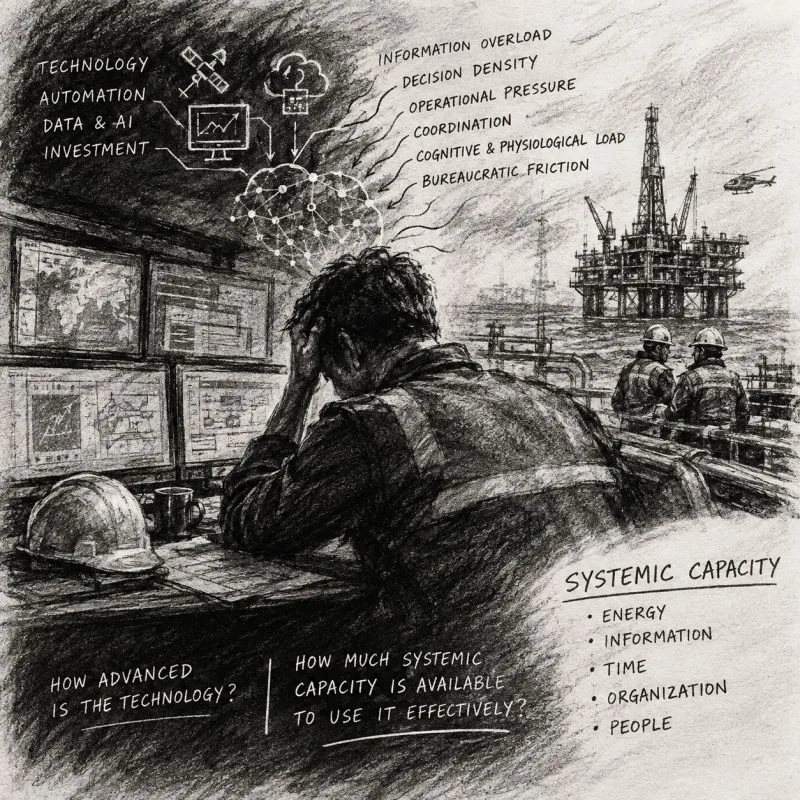
Why do highly engineered systems fail just when technology is most advanced?
In Oil & Gas and other complex operations, more technology does not guarantee better decisions: this piece examines systemic capacity, how much a system can absorb and turn into action under pressure.
NOTA-ECO-003 · Economy 5.0
Frankenstein and Oil: Why Does Venezuela Matter Geopolitically Again?
Third installment of the series: after tracing capital into AI and financial concentration, the next bottleneck comes into view, oil, and with it Venezuela returns to the geopolitical board.