

Economy 5.0 · NOTA-ECO-037
The New Scientific Method Is Not Replacing Science — It Is Expanding It
By Carlos J. Pérez Pulido · ISHEA Institute ·
Observation, experiment, mathematics and peer review brought us here. The argument is that the emerging method does not discard that rigor but widens its reach to complex, living systems.
Note — Short piece published openly. Thinking in progress, not a result.
🚀 The New Scientific Method Is Not Replacing Science—It Is Expanding It
Science has brought humanity to where we are today. The rigor of observation, experimentation, mathematics, and critical review remains the foundation upon which all discovery is built.
Artificial Intelligence does not change those principles.
It changes our capacity to explore them.
In the age of AI, scientific creation becomes a collaboration between human reasoning and computational capability. The machine can process information at unprecedented speed, but it cannot replace curiosity, intuition, or the ability to formulate meaningful questions.
Modern scientific creation can be understood in four interconnected stages:
1. The Researcher Leads
- Curiosity precedes computation.
- AI accelerates analysis, but humans define the questions.
- Insight remains a uniquely human responsibility.
2. Integrate Knowledge Across Disciplines
- The greatest discoveries often emerge at the intersection of fields.
- Classical science provides the foundations; interdisciplinary thinking expands them.
- Innovation connects ideas that previously appeared unrelated.
3. Formulate Falsifiable Hypotheses
- Every scientific proposition must be open to being tested—and potentially disproved.
- Clear variables and reproducible methods transform ideas into science.
- Critical scrutiny strengthens knowledge.
4. Build Meaningful Metrics
- Complex systems require new ways of measuring coherence, interaction, and change.
- AI enables the analysis of massive datasets, but meaningful metrics remain a human design challenge.
- Better measurements lead to better science.
💡 The future of research belongs neither to humans alone nor to machines alone. It belongs to researchers capable of combining scientific rigor, critical thinking, and artificial intelligence to ask better questions—and discover answers that were previously beyond our reach.
Science evolves. The scientific method evolves with it.
#ISHEA #ArtificialIntelligence #ScientificMethod #Research #Innovation #Epistemology #CriticalThinking #ComplexSystems #FutureOfScienceCreo
In the same room — Economy 5.0

NOTA-ECO-001 · Economy 5.0
What if the variables we use to measure national success were completely backwards?
For decades, progress has been measured through GDP, productivity, growth and energy use. This piece argues those variables may be inverted and asks us to rethink what it means for a country to thrive.
NOTA-ECO-002 · Economy 5.0
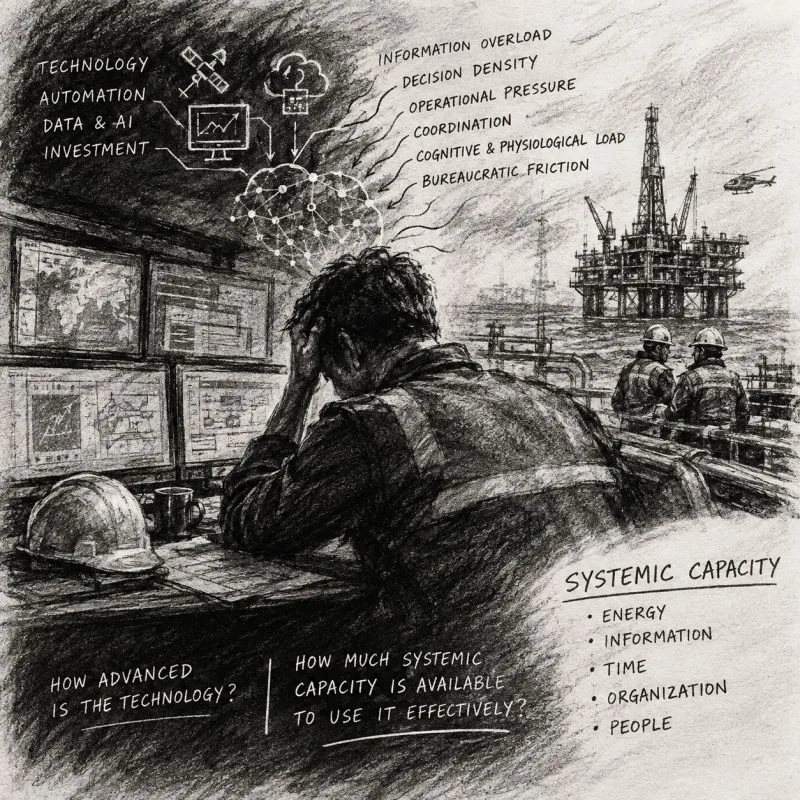
Why do highly engineered systems fail just when technology is most advanced?
In Oil & Gas and other complex operations, more technology does not guarantee better decisions: this piece examines systemic capacity, how much a system can absorb and turn into action under pressure.

NOTA-ECO-003 · Economy 5.0
Frankenstein and Oil: Why Does Venezuela Matter Geopolitically Again?
Third installment of the series: after tracing capital into AI and financial concentration, the next bottleneck comes into view, oil, and with it Venezuela returns to the geopolitical board.