

Economy 5.0 · NOTA-ECO-110
The Wreck-It Policy: Why the U.S. Chose Breakdown Over Negotiation in Venezuela
By Carlos J. Pérez Pulido · ISHEA Institute ·
A framework missing from mainstream analysis: some powers would rather see a system collapse than negotiate with it. The piece applies that lens to Venezuela and to how coercion is designed today.
Note — Short piece published openly. Thinking in progress, not a result.
🧨 The “Wreck-It Policy”: Why the U.S. Chose Breakdown Over Negotiation (The Venezuela Case)
There is a framework missing from most mainstream analysis — yet it explains almost everything we are witnessing.
👉 The United States is no longer trying to persuade, reform, or negotiate with certain regimes.
👉 It is neutralizing them through induced systemic breakdown.
Some analysts have begun to refer to this approach, informally, as the “Wreck-It Policy.”
What is it?
It is not classical diplomacy.
It is not nation-building.
It is not regime change à la Iraq.
It is colder and more structural:
> If a system is irreformable, it is broken. The vacuum is managed later.
🔑 What many are missing
1️⃣ Americans are not pacifists — they are pragmatic
The 47% who “have no opinion” are not opposition; they represent passive consent.
History shows how quickly this flips once a catalytic event occurs (1941, 2001).
2️⃣ Trump is not an extremist — he is transactional
Labels like “fascist” or “TACO” are tools of information warfare.
In practice, Trump 2.0 blends protectionism (historically left-wing) with geopolitical realism.
3️⃣ Fundamentals matter more than noise
Reindustrialization, cheap energy, nearshoring, and capital inflows are reshaping U.S. power beneath the media surface.
4️⃣ Capital already chose sides
When ~80% of global FDI flows into the U.S., this is not ideology — it is risk calculation.
🇻🇪 Why Venezuela is different
The logic applied to Venezuela is brutally clear:
❌ No attempt to “improve” the economy
❌ No incentives-based negotiation
❌ No gradual transition
✅ Total containment
>Any marginal revenue:
>Strengthens external lobbying,
>Sustains illicit networks,
& opens hemispheric space to China, Russia, or Iran.
☢️ The point of no return: FTO designation
Labeling a government-linked structure as a Foreign Terrorist Organization is not symbolic.
It provides full legal insulation for:
>Asset seizures,
>Financial isolation,
& future kinetic operations without additional political cost.
In Washington, language does not describe reality — it authorizes action.
“Terrorism” is a legal switch.
🧠 The deeper shift
The Western world has finally internalized a hard lesson:
Not all actors are rational partners.
Some operate outside the rule of law.
And against outlaw actors:
>Dialogue fails,
>Engagement fails,
>Concessions fail.
What remains:
1. force,
2. containment,
3. strategic patience.
📌 An uncomfortable conclusion
The Wreck-It Policy is not elegant.
It is not humanitarian.
It is not idealistic.
But it is not improvised.
It is the product of two decades of failed assumptions — and of a West that has stopped describing the world as it wishes it were, and started dealing with it as it is.
> Whether one agrees or not, this framework is likely to shape U.S. foreign policy well beyond any single administration.
#Geopolitics #USForeignPolicy #StrategicAnalysis #Realpolitik
#GlobalSecurity #GreatPowerCompetition #Venezuela
In the same room — Economy 5.0

NOTA-ECO-001 · Economy 5.0
What if the variables we use to measure national success were completely backwards?
For decades, progress has been measured through GDP, productivity, growth and energy use. This piece argues those variables may be inverted and asks us to rethink what it means for a country to thrive.
NOTA-ECO-002 · Economy 5.0
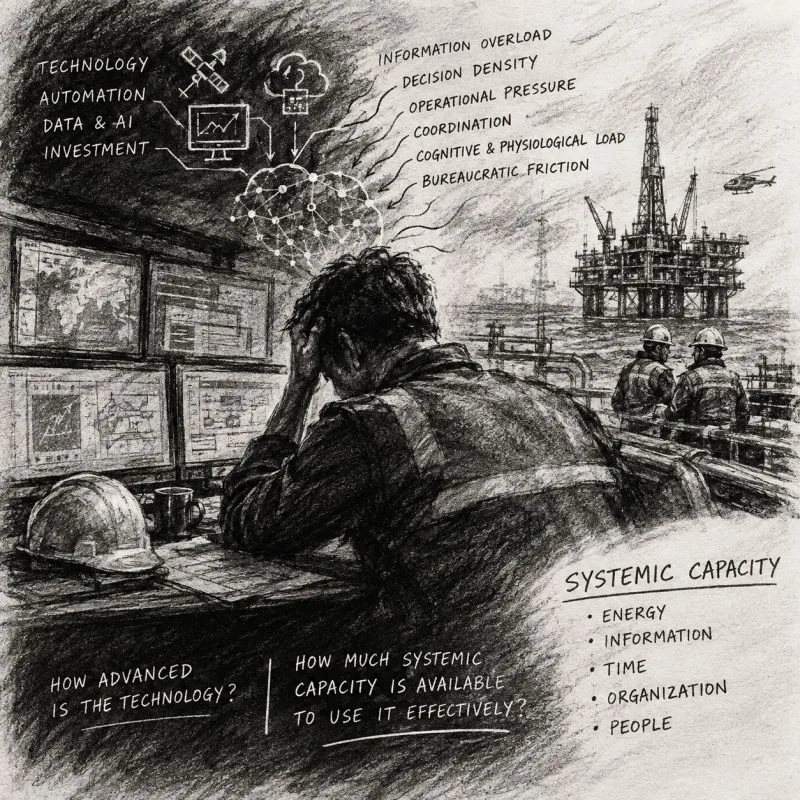
Why do highly engineered systems fail just when technology is most advanced?
In Oil & Gas and other complex operations, more technology does not guarantee better decisions: this piece examines systemic capacity, how much a system can absorb and turn into action under pressure.
NOTA-ECO-003 · Economy 5.0
Frankenstein and Oil: Why Does Venezuela Matter Geopolitically Again?
Third installment of the series: after tracing capital into AI and financial concentration, the next bottleneck comes into view, oil, and with it Venezuela returns to the geopolitical board.