

Economy 5.0 · NOTA-ECO-011
Venezuela 1999–2026: How Did We Get Here?
By Carlos J. Pérez Pulido · ISHEA Institute ·
A route from the start of the Chávez era, when Venezuela held extraordinary oil reserves, to 2026: the chain of decisions that explains the country of today.
Note — Short piece published openly. Thinking in progress, not a result.
🇻🇪 VENEZUELA 1999 → 2026
HOW DID WE GET HERE?
To understand Venezuela in 2026, you have to go back to 1999.
At the beginning of the Chávez era, Venezuela had something extraordinary:
Oil reserves + production capacity + technical talent + infrastructure + access to international markets.
The country did not lack resources.
It had a system capable of converting those resources into cash flow.
Then the model changed.
PDVSA stopped being treated primarily as an energy company and increasingly became an instrument for broader state objectives.
The argument was simple:
“The oil belongs to the people.”
And politically, it was powerful.
But economically, something was missed:
Owning the resource and managing the system that extracts it are two different things.
The consequences accumulated over time.
📉 Production capacity deteriorated.
📉 Investment and maintenance weakened.
📉 Technical talent was lost.
📉 Refining capacity deteriorated.
📉 PDVSA accumulated increasing fiscal and political responsibilities.
And eventually:
~3 million bpd → ~500,000 bpd
The oil did not disappear.
The capacity to monetize it did.
Now jump to 2026.
Venezuela still has approximately 303 billion barrels of proved crude oil reserves — the largest proven reserve base in the world.
And this creates the paradox:
🇻🇪 1999: Venezuela had the resource AND the machinery to monetize it.
🇻🇪 2026: Venezuela still has the resource — but needs to rebuild the machinery.
That is why today's geopolitical story is not simply about Venezuela's weakness.
It is about the enormous strategic value of rebuilding what was lost.
The country did not lose its oil.
It lost the system that transformed oil into power.
And that system can be rebuilt.
VENEZUELA’S LEVERAGE
Reserves → Investment → Production → Energy security → Geopolitical leverage.
The question for 2026 is no longer:
“What happened to Venezuela?”
It is:
“Who will help Venezuela convert what survived into what the world needs?”
🇻🇪 The story is not over.
#continue next post
#Venezuela #PDVSA #Oil #Energy #Geopolitics #Venezuela2026 #VenezuelaLeverage
In the same room — Economy 5.0

NOTA-ECO-001 · Economy 5.0
What if the variables we use to measure national success were completely backwards?
For decades, progress has been measured through GDP, productivity, growth and energy use. This piece argues those variables may be inverted and asks us to rethink what it means for a country to thrive.
NOTA-ECO-002 · Economy 5.0
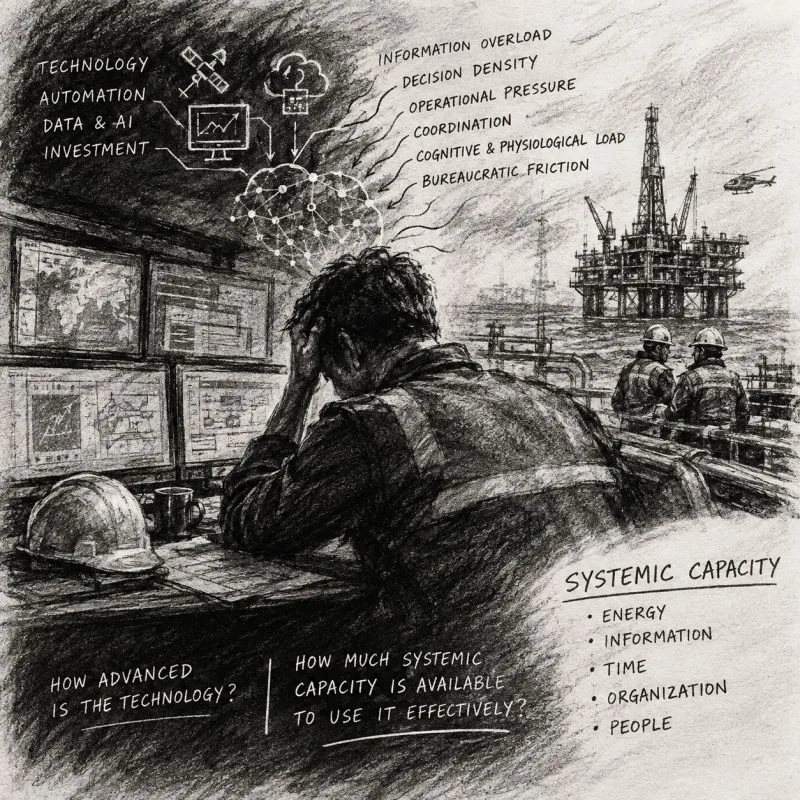
Why do highly engineered systems fail just when technology is most advanced?
In Oil & Gas and other complex operations, more technology does not guarantee better decisions: this piece examines systemic capacity, how much a system can absorb and turn into action under pressure.

NOTA-ECO-003 · Economy 5.0
Frankenstein and Oil: Why Does Venezuela Matter Geopolitically Again?
Third installment of the series: after tracing capital into AI and financial concentration, the next bottleneck comes into view, oil, and with it Venezuela returns to the geopolitical board.